Egma Meaning
slang · aesthetic compliment · updated 2026-11-04
A tightened-up enigma — someone mysterious, hard to read, a little intriguing.
What does egma mean?
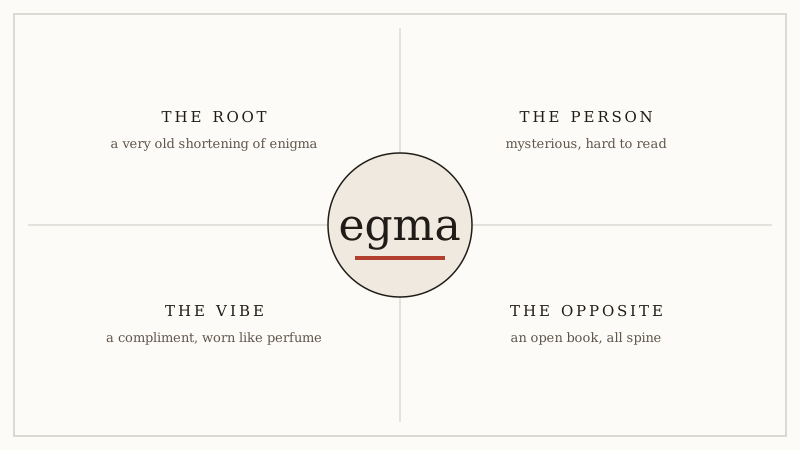
Egma is a shortened form of enigma — a person or thing that is mysterious, puzzling, hard to read. The egma meaning in one line: someone whose whole vibe is the question mark. Online it is used almost entirely as a compliment: the friend who never posts but somehow knows everything, the classmate with the flat expression and the eight-layer inner life, the account that follows no one and gets followed by thousands.
The word is doing aesthetic work, not literal work. Nobody calling someone an egma is claiming they are literally unsolvable — they are saying the unreadability is attractive, that the mystery is the charisma. Where "confusing" is a complaint, "egma" is a compliment: same behavior, better lighting.
And here is the part most people don't expect: the internet didn't invent this word. The Oxford English Dictionary records egma as an alteration of enigma with its earliest known use in the late 1500s — English speakers were clipping the word four centuries before the For You page. The TikTok era didn't create the shortening; it just rediscovered it, the way it rediscovered vinyl and tinned fish.
Where egma comes from
The root is ancient Greek — ainigma, from ainissesthai, "to speak in riddles." English borrowed it as enigma, and by the late 1500s the clipped form egma was already in circulation; the OED's citation trail runs straight through it. For most of the word's history it was a curiosity — the kind of variant that lexicographers note and everyone else ignores.
The 2020s revived it on two tracks. First, enigma itself had a moment: on TikTok, calling someone "an enigma" — often with the 💅 emoji — became a stock compliment for anyone attractively unreadable, and Merriam-Webster's definition of the word reads like it was written for the trend ("a person of puzzling or contradictory character"). Second, the clipped egma surfaced again in the same comment sections, doing what clipped forms do: saving half a second and looking cooler doing it.
So the honest etymology has two layers, like larps and 444 do: an old, legitimate word-history, and a new, algorithmic popularity. Neither layer cancels the other. The person commenting "he's an egma fr" is using a word with a 400-year paper trail and no idea they're doing it — which is, fittingly, a very egma way for a word to behave.
Enigma vs egma: what the clipping changes
The full word and the clipped word do different jobs, even though they mean the same thing:
- Enigma is the literary register — novels, documentaries, serious profile pieces ("the reclusive inventor remains an enigma"). It weighs more; it means a longer attention span.
- Egma is the comment-section register — fast, aesthetic, slightly ironic. It is a compliment you can type in half a second and it stays light on the tongue.
The clipped form also carries a whiff of insider knowledge. Using "egma" signals you spend time in the corners of the internet where the word circulates — the same effect that makes "larps" or "chud" read as terminally-online vocabulary. The full word is for essays; the clip is for comments under a video of someone staring into the middle distance.
When to use it (and when not to)
Egma works when the mystery is real, admired and mutual:
- describing the friend whose Instagram is nine posts and eleven years old — "she's an egma, we don't question it"
- complimenting someone's unreadable-calm energy — "you never react to drama, you're honestly an egma"
- self-description, ironically — "I'm such an egma" posted by someone who just explained their entire personality in a ten-minute video
Skip it when the "mystery" is actually avoidance: the person who ignores texts, dodges plans and calls it depth is not an egma — they're just unavailable with branding. The compliment fits genuinely private people; it flatters curated unavailability. And skip it entirely in anything serious — "my lawyer is such an egma" is not the reassurance you think it is.
Examples in the wild
"He has no posted history since 2021 and randomly knows everyone. Actual egma behavior."
"She's such an egma 💅 nobody in this group chat has ever seen her post a story."
"Bro said 'I'm an egma' and then explained his whole lore unprompted. My guy, you are an open book with a sticker on it."
"The new coworker answers every question with a question. Either an egma or hiding something, no in between."
Notice the two failure modes hiding in the examples: the ironic self-description ("I'm an egma" + full lore dump) and the suspicion reading (mystery as hiding something). The word lives between them — flattery when the mystery is mutual, side-eye when it isn't.
Is calling someone an egma a compliment?
Mostly, yes — and it's worth being precise about what exactly is being complimented. "Egma" praises opacity: the sense that there's more going on behind someone's face than they let out. In a culture where everyone narrates themselves constantly, unreadability has become scarce, and scarce things become prestigious. That's the whole economics of the compliment.
The reading flips when the opacity has a victim. The friend-group egma whose mystery is actually social anxiety isn't being complimented — they're being aestheticized, their discomfort repackaged as charisma. And the texting egma — the one whose mystery is just not texting back — is being complimented for something closer to negligence. The word is a compliment when the mystery is chosen and harmless; it's a misread when the "enigma" is struggling or simply flaking. Mystery admired is a compliment; mystery excused is an alibi.
How people get egma wrong
First, assuming it's an acronym. It isn't — no capital letters, no hidden expansion. EGMA does not stand for anything; capitalizing it is the fastest way to announce you think it's a military program. It is a clipped word, like "fridge" from Frigidaire or "dis" from disrespect.
Second, mixing it with sigma — the "sigma male" trend word. Adjacent vibes, different claims: egma is about legibility (hard to read), sigma is about hierarchy (lone-wolf status outside the social ladder). A person can be both, either, or neither; the comment sections conflate them daily, and now you don't have to.
Third, overgeneralizing it to things. "This math problem is such an egma" — the clipped form is for people and personas; for objects and puzzles, the full "enigma" is the word that carries the weight. The clip lives in the human-mystery register; sending it after a chess puzzle is like wearing sunglasses indoors — harmless, but a choice.
How egma relates to larps, chud and mogging
Egma completes the internet's person-taxonomy, and each neighbor sharpens it:
- Larps is the fake mystery — a persona performed to seem deeper than the person is. The egma's mystery is (allegedly) real; the LARPER's is staged. Same unreadable surface, opposite interior.
- Chud is the oversharer's opposite — the egma withholds, the chud replies to everything at full volume. One curates silence, the other weaponizes noise.
- Mogging needs legibility to work — you can only out-shine someone who can be compared. The egma refuses the scoreboard: can't rank what you can't read.
Together with larps, chud and mogging, the taxonomy closes: the fake, the repulsive, the dominant and the unreadable — and of the four, only the unreadable one gets the 💅.
Related slang
Questions people also ask
- What does egma mean?
- Egma is a shortened form of enigma — a person (or thing) that is mysterious, puzzling or hard to read. Online it is mostly used as a compliment: the intriguing friend nobody can figure out, worn like an aesthetic rather than a complaint.
- Is egma a real word?
- Yes — and it is older than you'd guess. The OED records egma as an alteration of enigma going back to the late 1500s. The internet did not invent it; the internet just clipped it again and handed it a TikTok aesthetic.
- What does egma mean on TikTok?
- On TikTok, egma (like enigma) describes someone deliberately hard to read — the friend with no posted history, the flat-voiced classmate, the account that posts nothing and follows no one. Comment sections use it as a compliment: 'she's such an egma.'
- Is calling someone an enigma or egma a compliment?
- Usually yes — mystery is flattering currency online. The reading shifts negative only when the mystery is an excuse, as in 'sorry I ignored your texts for a week, I'm an enigma.' Depth is a compliment; avoidance with branding is just avoidance.
- What is the difference between egma and sigma?
- Different words, adjacent vibes. Egma (enigma) is about being hard to read — mystery. Sigma is about being a self-sufficient loner outside the social hierarchy — status. An egma hides their depth; a sigma hides their effort. The comments mix them up constantly.
New here? Start with the slang guide — what slang are and where the readings come from.