Larps Meaning
slang · mocking, political edge · updated 2026-11-04
The internet's word for playing a role instead of being real — pretending, not living.
What does larps mean?
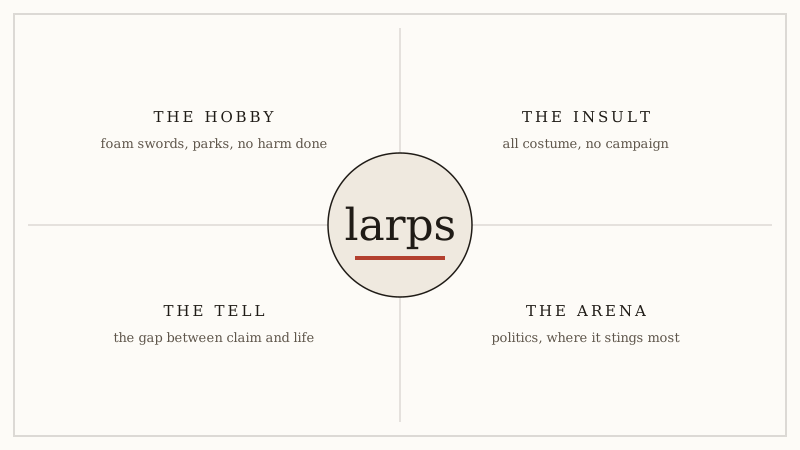
Larps is the internet's word for performing a role instead of being real. When someone says a person "is larping" or calls them a LARPer, they mean that person is playing a character — pretending to be a soldier, a revolutionary, an alpha, a self-made expert — rather than actually being that thing. The larps meaning in one line: all costume, no campaign.
The word is a verb, a noun and an accusation at once. You can larp (perform the fake role), be a larp (the performance itself — "this whole account is a larp"), or be a LARPer (the person doing it). All three forms carry the same core claim: there is a gap between who this person says they are and who they actually are, and everyone watching can see it.
That claim is what separates larps from its softer cousins. "Cringe" says you embarrass me. "Poser" says you borrowed a style. Larps says you are running a character — and like any accusation of fraud, it stings even though the word itself sounds almost silly. A foam sword is not a weapon, but "LARPer" is.
Where larps comes from
The word started as an honest hobby label. LARP — Live Action Role Play — grew out of tabletop role-playing games in the late 1970s and 1980s: instead of describing their characters around a table, players dressed up and acted out the story in parks and convention halls. That scene still exists, and in that context larping is a craft, not an insult — with national associations, weekend campaigns and a lot of sewing.
The mocking sense migrated online in the 2000s — Urban Dictionary entries from that era already define a LARPER as "someone who pretends to be something they're not" — and then hardened on forums in the 2010s, especially in political threads. Calling an online revolutionary a LARPER became a standard way to say: you would never act on this in real life; this identity is theater.
By the 2020s the larps meaning had loosened into everyday use, and it now covers almost any performed identity — fitness personalities, "traditional" influencers, crypto experts, stan accounts, day-trading gurus. TikTok accelerated the spread: the platform is a persona machine, so it needs a word for persona-accusation, and larp was sitting right there with twenty years of irony behind it.
LARP, larping, LARPer and larp: the forms
The word family is small but worth getting straight, because each form does slightly different work:
- LARP (all caps) usually means the hobby itself. "LARP weekend" is almost certainly about foam swords and fun. If someone uses all caps in an argument, they are being sarcastic about the hobby formality.
- larping is the activity in progress — "he's larping as a journalist." Lowercase almost always means the insult sense.
- LARPer (or larper) is the person: "he's just a LARPER." This is the form that lands hardest, because it reduces someone to the performance.
- larp as a noun is the whole false construction: "his tough-guy thing is a larp." It can also be a verb — "stop larping and do the work."
The safest reading in any online argument: lowercase and verb-like means mocking; uppercase and event-like means the actual hobby. Context decides, but that default rarely fails.
Political larping: the word's sharpest use
Politics is where "larp" does its heaviest lifting, on both sides of the aisle. The classic use mocks keyboard revolutionaries — the account posting "we must resist" whose total activism is posting. Calling that political larping says: the uniform is cosmetic, the war is aesthetic, nothing will ever be risked. It is a charge of cosplay patriotism or cosplay radicalism, and it lands because it reframes someone's sincere identity as a costume party.
The right fires the same word back — "electoral politics is a larp," "that newsroom is full of LARPers" — so the insult is not owned by one side. What both uses share is the structure: you are performing a role you will never live out. That symmetry is worth knowing, because it means the word will find you no matter your politics, and "who is it aimed at" matters less than "is the gap real."
Which is also the fair-test hiding inside the insult: some people posting in fatigues have served; some day-traders have positions. Larp is a claim, not a law. If the claim is false, the word is just slander with a fantasy painted on it.
When to use it (and when not to)
Larps works when you are calling out performance as performance:
- reacting to someone whose online identity is obviously staged — "nobody talks like that in real life, this is pure larp"
- describing a subculture that treats ordinary life like a character sheet — fitness LARPers, doomsday LARPers
- politics, where it is a pointed accusation: all symbolism, no action
- self-deprecatingly about yourself — "I've been larping as a morning person for a year" — where it reads as charm instead of attack
Skip larps when you just mean "cringe" or "I dislike this." The word carries a specific claim of fakeness — using it as a generic insult flattens it. And in a workplace or professional setting, "he's larping as a CFO" reads as an actual accusation of fraud, so it is not a phrase for polite email.
Examples in the wild
"He's been larping as a day-trading guru for a year. His only position is his dad's Netflix account."
"Tactical vest, no plate carrier, no training. Pure LARPer energy."
"Every 'we must fight' post from an account with 12 followers is just political larping."
"I loved her cottagecore era but we all knew she was larping — she ordered the bread from a bakery."
"Comment section full of people larping as economists. None of you know what a basis point is."
Notice the pattern in all of these: each one names the claimed role (guru, tactical expert, activist, cottagecore girl, economist) and then shows the gap (no positions, no training, 12 followers, bakery bread, no basis points). That structure — claim, then gap — is the engine of the word. A larp accusation without the gap is just an opinion.
Is calling someone a LARPer offensive?
It is mocking rather than obscene, but do not mistake "clean" for "gentle." A LARPER insult says the person is faking — which is an attack on authenticity, the thing most people care about most. It is not a slur: it targets no group, carries no history of violence, and gets used across every political tribe. But in a serious argument it lands as a real accusation of dishonesty, closer to "fraud" than to "dork."
The register test: among friends joking about a reality-show villain, LARPer is a laugh. Under a stranger's sincere post, it is a broadside. The word itself never changed — only the distance between you and the target did.
How people get larps wrong
Three mistakes dominate. First, assuming larps always refers to the hobby — if a LARP club posts about their weekend event, they mean the real activity, not the insult; context decides. Second, using it against anyone who is simply enthusiastic. A person who genuinely loves medieval fencing is not larping; a person who poses with rented swords and claims knighthood is. The word targets the gap between the claim and the life, and if there is no gap, there is no larp.
Third — the newest mistake — treating larp as a synonym for "lying." Larps is specifically about performing an identity, not about telling falsehoods. A liar wants you to believe a fact; a LARPER wants you to believe in a character. You can catch a liar with a fact-check, but you catch a LARPER by looking at the life behind the profile. Different crime, different evidence.
How larps relates to chud, mogging and egma
Larps sits in a cluster of words the internet uses to describe people rather than things, and each neighbor shows it off:
- Chud attacks from the other direction — not "you're faking a persona" but "your persona is repulsive." Larps accuses the performance; chud condemns the performer.
- Mogging is about status by comparison — out-shining someone on sight. A LARPER tries to win the comparison by acting; a mogger wins it by arriving.
- Egma is the flattering one: a mysterious, hard-to-read person. Where a LARPER hides a real self behind a fake one, the egma wears mystery as the real self — which is why one word insults and the other admires for the same behavior.
Together they map the internet's whole taxonomy of persons: the fake (larps), the repulsive (chud), the dominant (mogging) and the unreadable (egma).
Related slang
Questions people also ask
- What does larps stand for?
- LARP stands for Live Action Role Play — originally the hobby where people act out fantasy characters in real life, in costume, with foam swords. Online, larps stopped meaning the hobby and became a mocking word for anyone performing a role instead of being genuine.
- Is calling someone a LARPer offensive?
- It is mocking rather than obscene. A LARPer insult says the person is faking — pretending to be a soldier, an activist, an expert — so it is an attack on authenticity, not a slur. In a serious argument it lands as a real accusation of dishonesty.
- What is the difference between LARP, larping and a LARPer?
- LARP is the activity, larping is the act of doing it, and a LARPer is the person. Online all three usually carry the mocking sense: someone larps a persona, and if you call them a LARPer you are saying the persona is fake.
- What does larp mean on TikTok?
- On TikTok, larp (or larping) means performing a persona for the camera — the staged luxury lifestyle, the manufactured aesthetic, the expert who is actually an amateur. Comments saying 'this is a larp' are calling the performance fake.
- Is larping a bad word?
- It depends on the setting. Among the role-play hobby's own community, larping is just the activity and entirely neutral. Everywhere else online, calling someone a larp or a LARPer is an insult — mild in tone, but a real accusation of fakeness.
- Can you call yourself a larper?
- Yes, and people do — self-deprecatingly. 'Honestly I'm larping as an adult' means you feel like you're performing the role rather than living it. Used about yourself, the word loses its sting and becomes a joke about pretending to have it together.
New here? Start with the slang guide — what slang are and where the readings come from.