Mogging Meaning
slang · playful, can feed insecurity · updated 2026-11-04
Outshining someone on sight — gym slang for dominating the looks comparison.
What does mogging mean?
Mogging means outshining or dominating someone — most often in looks. If a person walks into the room so clearly better put-together that everyone else fades into the background, they are mogging the room. The mogging meaning in one line: a comparison you lose just by standing there.
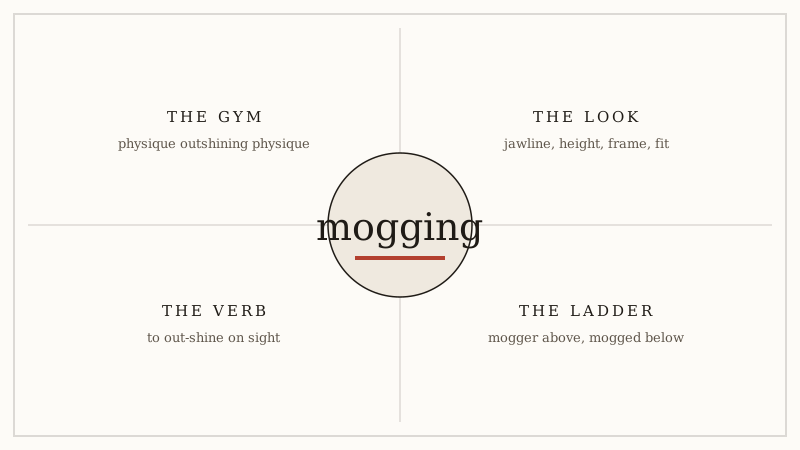
The word family is a complete grammar of the status game. To mog is the verb — to out-shine on sight. A mogger is the one doing the out-shining. To be mogged is to lose the comparison — sometimes spectacularly ("he got mogged by his own reflection"). And it has all spread outward from the gym, where the original comparisons were made in mirrors, to every context where humans are ranked by presence: the group photo, the party, the timeline.
The word went fully mainstream recently — Collins Dictionary named "mogging" a Word of the Year as Gen Z and Gen Alpha usage exploded through TikTok — which means you will now see it in places that have never touched a barbell: fits (outfit) comparisons, jawline discourse, even food ("this restaurant moggs the one next door"). Once a word starts ranking restaurants, it has officially become a general-purpose verb for dominating by comparison.
Where mogging comes from
Most accounts trace the word to pickup-artist forums of the 2000s, where AMOG — "alpha male of group" — was a verb waiting to happen: to AMOG someone was to assert dominance over the group's supposed leader. Strip the acronym down and you get the bare verb: to mog. From there the word migrated to bodybuilding and gym forums, where it found its natural home — gyms are rooms full of people voluntarily standing next to each other in various states of shirtlessness, which is to say: comparison machines.
The 2020s looksmaxxing wave did the mainstreaming. TikTok's appearance-ranking culture — jawline routines, bone-smashing trends, "canthal tilt" discourse — needed a vocabulary for ranking humans, and mogging was already built for it: short, punchy, with a ready-made loser category (mogged) for every winner. From gym mirror to For You page, the word completed the journey from niche jargon to Collins-dictionary-listed vocabulary inside a decade.
That origin matters for tone. This is not a neutral observation word — it was born in spaces that ranked men against each other on purpose, and it kept the scoreboard energy everywhere it went.
The social math: mogger vs mogged
Every mogging claim implies a scoreboard. The mogger wins the comparison by arriving; the mogged loses it by standing nearby. The comparisons are silent, instant, and — in the word's native habitat — considered fair game for commentary.
That math explains the word's emotional range. Mogging is a boast when aimed outward ("walked in mogging the whole party") and a shrug when aimed at yourself ("got mogged at the beach, it's fine"). The one context it turns genuinely cruel in is when it's aimed at a third person who didn't opt into the ranking — that's when the gym-culture scoreboard starts doing body-shaming's work for it.
There's also a quiet rule about what is being compared. Classic mogging is physique (the gym inheritance), but the word now ranks height, jawline, frame, outfits ("fit mogging"), even hairlines. What it does not rank, in careful usage, is effort — mogging is about arriving superior, not trying hard. That's why "trying too hard" accusations pair with it so often: visible effort is read as evidence you were losing to begin with.
The kinds of mogging people actually name
Looksmaxxing communities, being communities, catalogued everything. The taxonomy you'll see most:
- Height mogging — standing next to someone shorter, vertically ending the conversation
- Face mogging — jawline, cheekbones, the camera-loving face winning the frame
- Frame mogging — broad shoulders and clavicle-to-waist ratio doing the work
- Fit mogging — the outfit so deliberate that everyone else looks like they got dressed in the dark
- Gym mogging — the original: a physique that makes the adjacent bench press look decorative
- Money mogging — the newest extension: out-spending as out-shining, usually sarcastically
Two things are worth noticing about this list. First, most of it is fixed at birth — height and frame mogging rank skeleton, which is why the word sits so close to body-image rabbit holes. Second, the categories multiply on purpose: every new ranking axis is another chance to win or lose, which is the whole engine of looksmaxxing content and the reason the vocabulary keeps expanding.
When to use it (and when not to)
Mogging works in two registers:
- playful self-deprecation — "got mogged by a 19-year-old in line for coffee, so that's where I'm at"
- honest compliments with a smirk — "her fit mogged the entire wedding, respectfully"
- gym banter among friends who trade the joke both ways
Skip it when the person you're ranking didn't opt into the game: strangers' bodies in your captions, friends who are sensitive about the exact axis you're joking on, anyone in a vulnerable moment. The word's whole grammar is ranking humans — used carelessly, it teaches everyone watching that grading people is the default. Used between consenting friends, it's just gym humor with better marketing.
Examples in the wild
"Bro walked in mogging everyone with his physique. The light literally favored him."
"Got mogged at the beach by a guy who was clearly cast by a casting director. I've accepted it."
"She fit-mogged the whole function and left early. Icon behavior honestly."
"This corner bakery moggs the supermarket bread so hard it's not a competition."
Notice how the word flexes registers: physique, outfit, even bread. And notice the last one — when mogging attaches to inanimate objects, the ranking game has become so normal that even bakeries can win it. That's the sign of a fully naturalized slang word: it no longer needs humans to rank.
Is mogging mean or body-shaming?
It can be, and the honest answer tracks the scoreboard culture it came from. Between friends trading the joke in both directions, mogging is banter — the same gym-humor that produced the word. Aimed at strangers, attached to photos they didn't consent to being ranked in, or aimed repeatedly at one person's fixed traits (height, frame, face), it stops being a joke and becomes the looksmaxxing community's actual product: teaching people to grade humans constantly, starting with themselves.
The fair test is consent and direction. Mogging yourself, or the bit you and your friends agreed to: fine. Mogging someone who is just standing in your frame: you're doing body-shaming with a funnier name. The word didn't create the insecurity spiral — looksmaxxing spaces did — but it is those spaces' favorite unit of currency, and spending it carelessly funds the whole machine.
How people get mogging wrong
First, the spelling collision: mogging is not mugging. Mugging is a street robbery; mogging is an appearance domination. No one has ever been mogged in an alley — though "got mogged by my own passport photo" is a sentence the English language is now legally allowed to contain.
Second, assuming mogging is about effort. It's the opposite — the mogger wins by arriving, visibly trying reads as evidence you were already losing. The word's whole mythology is effortless superiority, which is why "trying to mog" is itself a recognizable (and embarrassing) genre of behavior.
Third, treating it as romance. Mogging is not flirting and not "mugging someone off" (British slang for disrespecting a partner). You can mog someone you've never met and never will. It's a comparison, not a relationship.
How mogging relates to larps, chud and egma
Mogging sits with the internet's person-describing words, and each neighbor marks a boundary:
- Larps fakes the win — a LARPER performs the superior persona; a mogger is read as actually having it. One is an accusation, the other a (grudging) ranking.
- Chud is the anti-mog — the insult presupposes its target loses every looks comparison on sight. Pairing the two ("gym mogging or chud behavior, nothing in between") is how timelines now sort every man with a fitness post.
- Egma opts out of the ranking entirely — the mysterious one who can't be scored because they can't be read. Mogging needs the comparison to land; the egma denies you the legibility.
Together with larps, chud and egma, they map the internet's person-taxonomy: the fake, the repulsive, the dominant and the unreadable.
Related slang
Questions people also ask
- What does mogging mean in slang?
- Mogging means outshining or dominating someone, most often in looks — a physique, jawline or outfit so far ahead that the other person looks worse by comparison. It started in gym slang and went mainstream through TikTok's looksmaxxing wave.
- What does 'I got mogged' mean?
- It means you lost a looks comparison decisively — someone nearby was so much better put-together that you faded into the background. Said about yourself, it is usually self-deprecating humor rather than a real complaint.
- What is a mogger?
- The mogger is the person doing the out-shining — the one whose presence makes everyone else in the frame look like the before picture. In looksmaxxing spaces it is a status title; used casually, it is a compliment with a smirk attached.
- Is mogging the same as mugging?
- No — different word entirely. Mugging is a street robbery; mogging is an appearance comparison. The confusion is common because the words look alike, but no one has ever been mogged in an alley. They just looked slightly worse there.
- Is mogging body-shaming?
- It can be. Playful between friends who consent to the bit, mogging is harmless banter. But in looksmaxxing communities the word grades human beings against each other all day, and that grading is exactly the habit body-image researchers warn about. The word is only as mean as the ranking culture it came from.
New here? Start with the slang guide — what slang are and where the readings come from.