IDK Meaning
acronyms · neutral; the honest default · updated 2026-11-04
'I don't know' — the shrug, typed.
What does IDK mean?
IDK stands for "I don't know." It is the plainest acronym in the language — an honest head shake, typed. The IDK meaning in one line: the shrug, rendered in three letters. No attitude (that's idc), no judgment (that's smh), no emotion at all, really — just the accurate report that the speaker's map has a blank where your question pointed. "What time does it open?" "idk." Complete, honest, conversationally closed.
The acronym's power is its neutrality. Most texting shorthand carries a temperature — wyd is an approach, tbh is a confession, smh is a verdict. IDK carries none: it is the rare initialism with no weather. That makes it the safest answer in the language and, in certain moments, the coldest — because a reply with no temperature, aimed at a question with high temperature, reads as refusal. The letters are innocent; the stakes decide.
IDK is also the workhorse of the set. Linguists analyzing chat corpora keep finding i-d-k among the most frequent three-letter sequences in English messaging — it answers questions of fact ("idk her name"), plan ("idk what to do tonight"), opinion ("idk if I liked it") and feeling ("idk how I feel about that"), which is four jobs for three letters. No other acronym covers so much conversational territory with so little personality.
Worth knowing what idk is not: it's not idc (the single most consequential letter-swap in texting), it's not "idc disguised" (most idk really is not-knowing), and it's not lazy — it's often the most honest answer available, and pretending to know is the actual failure mode it prevents.
Where IDK comes from
The lineage is the standard one: chat rooms and forums in the 1990s compressed the most common phrases, and "I don't know" was arguably the most common phrase in need of compressing. IDK circulated alongside lol, brb, and imo through AIM, MSN Messenger, SMS and beyond — Urban Dictionary logged it by 2002, already defined exactly as today. There was never a moment when idk meant anything else, which in slang terms makes it less a coinage than infrastructure — it arrived and never changed.
Two later chapters gave the stable word its modern shape. First, the 🤷 emoji (shoulder shrug, standardized 2010s) gave idk a face — the two now travel as a pair, and the emoji alone (or the elaborate ¯\(ツ)/¯ kaomoji that preceded it) can serve as the entire reply. Second, dictionaries caught up: Merriam-Webster entered IDK in the mid-2010s, one of the first texting initialisms to make the jump, citing its ubiquity in monitored citation corpus. A word is officially mainstream when the dictionary files it and your boss uses it — both happened.
The current status: idk is invisible English — no trend cycle, no cringe risk, no generational ownership dispute. It's on the short list of internet initialisms that stopped being internet slang and became simply the language, the way "okay" stopped being a fad in the 1830s and got itself an entry in every dictionary since.
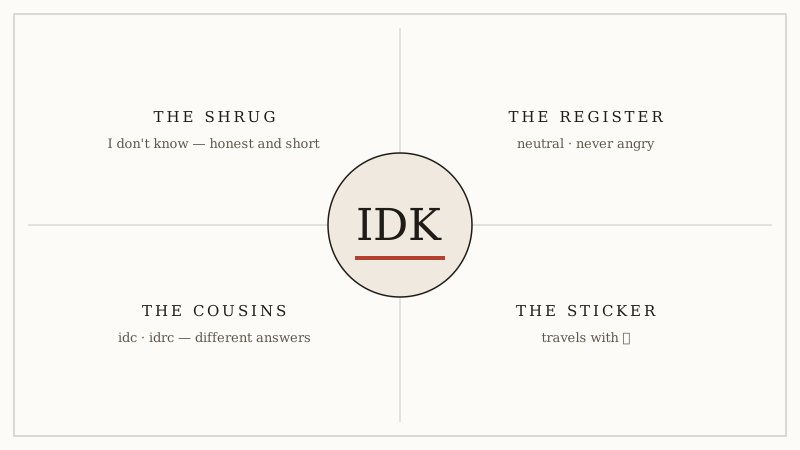
IDK vs IDC vs IDRC: the one-letter wars
The acronym's closest neighbors are one mutation away, and the differences are the difference between peace and conflict:
- IDK — "I don't know." No information. Head shake. Keeps the conversation alive by honestly reporting a blank.
- IDC — "I don't care." No investment. Wave-off. Kills conversations (or starts arguments) because it dismisses the question's project — "idc" to "where do you want to eat?" translates to "I have resigned from this decision and possibly from pleasing you."
- IDRC — "I don't really care." IDC with the modifier of fatigue — a softer, wearier wave-off that concedes involvement but announces its exhaustion. Common in long-running plan threads at hour three.
The classic disaster is the typo: "idk" → "idc" by one key, or autocorrect choosing the wrong sibling. The receiving end cannot see the mechanism; they see the message. Advice with zero poetry in it: proofread your k's and c's. Meanwhile, "idc" meant sincerely is still legitimate — apathy honestly declared is a form of information ("pick without me, I have no preference and will be happy"). The insult is not the letters; it's the flick.
When to use it (and when it goes cold)
IDK fits everywhere honesty fits:
- facts and plans: "idk what time it starts — check the site?"
- opinions under low stakes: "idk, both are fine" (the merciful death of a circular debate)
- feelings, carefully: "idk how I'm feeling about it" — legitimate, provided the receiver reads it as not yet languageable rather than no
The cold mode is specific: idk as the complete reply to a high-stakes question. "Do you see a future here?" — "idk" is honest and it is a brick. The repair is one clause of direction: "idk — I need to think about it" or "idk, can we talk Thursday?" The acronym's neutrality is a gift when the stakes are low and an amputation when they're high; the fluent move is adding the next step whenever the question deserved one.
Professional contexts follow the same rule at a higher spelling tax: idk lives in quick internal chat (everywhere, increasingly) and gets spelled out — "I'm not sure yet; I'll confirm by EOD" — in client email, where the follow-up clause is the actual product and the uncertainty is just its container.
Examples in the wild
"what do you want for dinner" "idk" "ok pasta or tacos" "tacos" — every couple, every night, since 2003
"do you think she's mad at me? idk I can't read her"
"idk how to feel about the finale 🤷 tbh it needed 2 more episodes"
Notice the grammar: idk is a complete sentence — subject, verb, object, all three letters, no punctuation needed. It stands alone (examples one and two) or hedges the front of a longer take (example three, where it pairs with tbh: the double-hedge construction "idk tbh" is modern texting's most honest formula — no knowledge, no filter, full disclosure of both).
How people get IDK wrong
Three recurring mistakes — and note that idk forgives more than its siblings, so all three are minor crimes. First, the k/c typo in either direction (covered above; proofread). Second, the shrug-dump — using idk to resign from every decision ("idk, idc, whatever you want"), which outsources all the labor of the relationship to the other party and reads as slow-motion contempt even when it's genuine fatigue. Third, the stone wall — one bare "idk" to a question that clearly carried stakes, when one added clause ("idk, I'll know by the weekend") would have converted absence into process.
How IDK relates to WYD, LMK and friends
IDK sits in the texting-acronym family this site tracks, and the neighbors mark its job:
- WYD asks the question idk most often answers: wyd tonight? idk. The two are a matched set of plan-making ping-pong.
- LMK is idk's professional superior: where idk states the gap, lmk assigns the follow-up — "idk, lmk what you decide" is the full handoff in six letters.
- TBH hedges opinions; idk hedges knowledge — "tbh idk" is the double hedge, modern texting's most honest formula.
- TLDR is what idk says when it's being asked to read something long.
The family map: wyd asks, idk doesn't know, lmk routes the follow-up, tbh softens whatever's left. If the meaning of IDK could be reduced to one line: "I don't know" — the most honest three letters in the language, safe everywhere, warm mostly, and only a brick when aimed at a question that deserved a clause more.
Related acronyms
Questions people also ask
- What does IDK mean?
- IDK stands for 'I don't know' — the plain admission of not knowing, compressed to three letters. It's the default honest answer to questions of fact, opinion or plan ('idk what to eat,' 'idk if I'm going'), and the most neutral acronym in the texting set: no judgment, no drama, just the shrug.
- What is the difference between IDK and IDC?
- The K/C swap changes the whole message: IDK is 'I don't know' (no information — head shake), IDC is 'I don't care' (no investment — wave off). 'Where do you want to eat?' 'idk' keeps the conversation alive; 'idc' starts a small fight. Fluent texters type carefully around that one letter, and autocorrect has ended friendships.
- Is IDK rude?
- On its own, no — it's the most polite acronym available, honestly reporting a knowledge gap. It reads cold only when used as a full reply to something serious: 'do you still want to be together?' 'idk' is technically honest and emotionally a brick. The letters are neutral; the conversation's stakes decide whether neutrality is kindness or absence.
- What does IDK mean in work email?
- Same meaning, riskier venue. In professional channels, idk is acceptable in quick internal chats (increasingly common even between managers and reports), but in client-facing or formal email the spelled-out equivalents read better: 'I'm not sure — I'll check' adds the follow-up that bare 'idk' lacks. The acronym states the gap; professionals get paid to also state the next step.
- How do you respond to IDK?
- It depends what the idk is about. Plans ('idk where to eat'): propose two options — decision by menu beats decision by committee. Facts ('idk what time it opens'): volunteer to find out, or let it go. Feelings ('idk how I feel'): give space — an idk about emotions often means 'I'm not ready to language this yet,' and pressing converts not-knowing into defensiveness.
- Is IDK an acronym or an abbreviation?
- Technically an initialism — you say the letters ('eye-dee-kay'), not a word (the way NASA or FOMO work). In casual classification everyone files it under 'acronyms' anyway, and dictionaries have stopped fighting the public on it. The purist distinction still matters somewhere: on this site's own acronym guide, where idk gets to be the textbook example.
New here? Start with the acronyms guide — what acronyms are and where they come from.