LMK Meaning
acronyms · neutral request; work-safe · updated 2026-11-04
'Let me know' — the ball is in your court, politely.
What does LMK mean?
LMK stands for "let me know." It is a request and a handoff in one: the ball is in your court, and I am politely not standing over you while you hold it. The LMK meaning in one line: "let me know" — the courtesy handoff, three letters wide. "lmk if you're coming" asks a question, assigns the answering of it, and closes the message in perfect neutrality. No urgency is conveyed, none is hidden — the acronym is famous for being exactly as demanding as it looks.
LMK is the office-friendly member of the texting set. Where wyd belongs to the group chat and smh to the comment section, lmk travels between both worlds without changing clothes: it's equally at home ending a text to a friend ("lmk what you decide") and closing a Slack thread ("lmk if that works for you"). That portability comes from its function — a coordination tool rather than an expression — and coordination is the one job every context has.
The word's quiet power is that it creates an obligation without issuing an order. Receiving an lmk means: you now owe me an update, at a time of your choosing, and the debt is real but the interest rate is zero. Almost all of lmk's failure cases — the chase-loops, the passive-aggression — come from that debt being unpaid, which tells you the acronym works; people only resent instruments that function.
Worth knowing what lmk is not: it's not urgent (that's "call me"), it's not a deadline (unless you attach one), it's not FYI (the arrow points the other way), and — the important one — it's not a no-op. Every lmk creates a small pending task. Send them accordingly.
Where LMK comes from
The acronym follows the classic compression lineage — 2000s forums, chat, and SMS abbreviating the phrases coordination actually needed. "Let me know" was prime compression material: a full sentence whose only job is procedural. Urban Dictionary logged lmk by the mid-2000s, defined exactly as now, and the word never looked back — one of the small class of initialisms (with brb, btw, fyi) that found a permanent register and simply stayed.
The interesting chapter is the workplace crossing. Most texting shorthand hits the professional border and stops (your boss does not want wyd). LMK cleared it in the 2010s as workplace chat — Slack, Teams, and the general Slackification of email — adopted texting's coordination vocabulary for actual coordination. The acronym had two advantages in the crossing: its neutral register (nothing casual about the content, only the spelling) and its deadline compatibility — "lmk by EOD Friday" slots into email grammar as if it had been designed there, because functionally it was.
Current status: fully dual-citizen. LMK is standard in personal texting, workplace chat, and — with judgment — client email; it clusters in the wild with its office cousins (fyi, tbd, eod, eta) and its social ones (wyd, idk, tbh), and the two clusters are increasingly the same cluster. An acronym that ends a wedding-group text and a vendor thread with equal propriety is doing something rare: it found the overlap between two registers and moved in permanently.
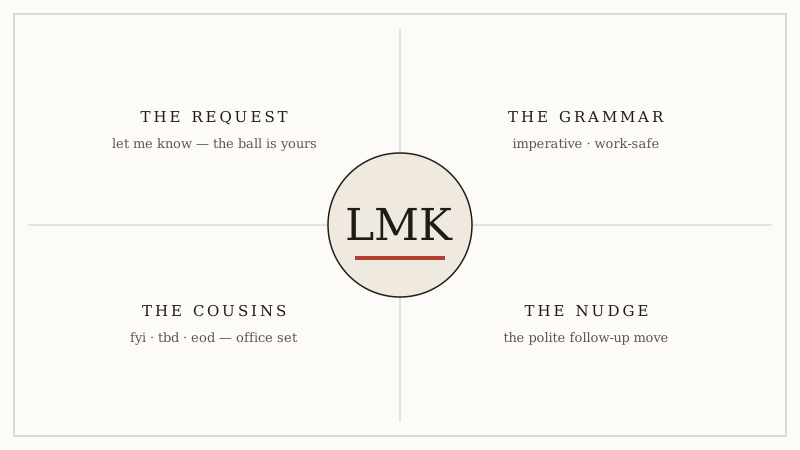
LMK vs the office set: FYI, TBD, EOD
LMK belongs to a small cluster of procedural acronyms, and keeping their arrows straight is the entire skill:
- LMK — request, arrow toward you. "Lmk when you land." You are the destination; the information should arrive.
- FYI — announcement, arrow away from you. "Fyi, the time changed." You are the source; no reply is requested (which is what makes fyi a release and lmk an obligation).
- TBD — placeholder. "Time TBD." Not a request, not an answer: a labeled blank, promising future information from an unspecified source. TBD is the empty chair; lmk is the person who fills chairs.
- EOD — deadline. "lmk by EOD." The timestamp that converts a courtesy into a schedule. LMK+EOD is the standard unit of modern office coordination: a polite request with a fence around it.
The genre these four share: they're workflow words — they don't express anything, they route things. That's why they survive register changes and platform changes and generation changes. Emotions go out of date; logistics is forever.
The two-lmk problem: politeness and its expiration
LMK's one genuine dark art is the second lmk. The first is a neutral request. The second — "just lmk when you get a chance 🙏" — is a chase wearing the same clothes, and everyone reads it as one: the debt is now overdue and the creditor is smiling about it. By the third lmk the message has left the acronym economy entirely; it is a passive-aggressive escalation with plausible deniability, and both parties know it.
The fluent protocol: one lmk, one gentle chase (different channel if possible), then a phone call or an in-person ask. The phone call feels like an escalation because it is one — but it's the honest escalation, and it lands softer than the third lmk, which is the only version of the message where the politeness itself is the aggression.
Related etiquette: lmk is also the standard release valve when you don't have the answer yet. "Nothing yet — will lmk by EOD" pays the debt's interest on time, keeps the loop warm, and costs six letters. Modern coordination runs on exactly these micro-payments; the people who make them are the people whose lmk-to-you still means something by Thursday.
Examples in the wild
"2 extra tickets came up for friday. lmk asap if you want one"
"Per my last email, could you lmk by EOD so we can close the loop on this?" (the office cousin says hi)
"he said 'lmk what you decide' three days ago and I still haven't decided and the lmk is just SITTING there"
Notice the grammar: lmk almost always appears clause-final or message-final — it closes, it doesn't open (you almost never see "lmk! also, dinner was great"). It pairs naturally with deadlines ("by EOD," "asap," "by thursday") and with the conditional that created the debt ("if you want one"). And the third example is the genre's confessional: the lmk received, sitting unanswered, accruing — because everyone knows the acronym's neutrality expires.
How people get LMK wrong
Three recurring mistakes. First, arrow confusion — using lmk where fyi belongs ("lmk, the meeting moved to 3") which requests replies to an announcement and reaps confusion. Second, delegation abuse — lmk-ing your own homework ("I'll lmk what I find out" where you're the only party involved; that's a note to self, not a message). Third, urgency mismatch — sending lmk when the situation is on fire: the acronym's defining property is its zero interest rate, and using it in an emergency quietly tells the receiver the fire is figurative. "Call me" exists precisely for the times lmk would be a lie.
How LMK relates to IDK, RSVP and friends
LMK sits in the acronym family this site tracks, and the neighbors mark its job:
- IDK is the state; lmk is the routing — "idk yet, lmk what you want to do" chains the gap and the follow-up in six letters.
- RSVP is lmk's formal ancestor: respond, if you please. Same debt, courrier dress — one born in French etiquette, the other in SMS, both chasing headcounts.
- TLDR summarizes; lmk solicits — the reader's shortcut vs. the writer's request, the two poles of information flow.
- SMH is what the third lmk earns — the judgment that arrives when politeness has been weaponized past its expiration.
The family map: rsvp is the formal ancestor, lmk the modern handoff, idk the honest gap, smh the chase's verdict. If the meaning of LMK could be reduced to one line: "let me know" — the politest debt instrument in the language, interest-free until the second sending.
Related acronyms
Questions people also ask
- What does LMK mean in texting?
- LMK stands for 'let me know' — a request for information or an update, and a handoff: the ball is now in your court. 'lmk if you're coming' both asks the question and transfers responsibility for answering it. It's the politest three-letter request in the set — no urgency, no pressure, just the door left open.
- Is LMK professional?
- Largely yes — lmk is one of the few texting acronyms that crossed into workplace chat and survived. In Slack/Teams it reads as normal efficiency; in client-facing email it's a judgment call (fine with a casual client, spelled out with a formal one: 'please let me know by Friday'). The safest rule: match the register of the person who wrote last.
- What is the difference between LMK and FYI?
- Opposite directions of information flow. LMK asks — it requests that information come TO you ('lmk when you land'). FYI informs — it sends information OUT ('fyi, the time changed'). Confusing them reverses the arrow: 'fyi if you can make it' is a sentence nobody meant to write.
- How do you respond to LMK?
- You owe an update when the information exists — that's the debt lmk creates. If the answer is 'still don't know,' the response is the mini-lmk: 'nothing yet, will lmk by EOD.' Silence is the only real violation: lmk is a handoff, and dropping the ball it handed you is what the second lmk exists to chase.
- What does LMK mean in email?
- Same meaning, mildly formalized: 'Let me know if that works' closes a loop and delegates the next move. In email it clusters with its office cousins — fyi, tbd, eod, eta — and usually comes with a deadline attached ('lmk by Thursday'), which is the difference between a request and a scheduled one.
- When should you use LMK?
- Use it when you genuinely need the update but genuinely don't need it urgently: plan-confirmations, availability checks, 'lmk your thoughts.' Skip it when you need action NOW ('call me' beats 'lmk'), when you're the one who should act (don't delegate your own homework), and after the third lmk — at that point it's no longer an acronym, it's a passive-aggressive escalation, and a phone call is the honest version.
New here? Start with the acronyms guide — what acronyms are and where they come from.