What Is an Acronym?
acronyms guide · updated 2026-11-04
Initials spoken as one word — the compression trick behind half of texting.
The definition
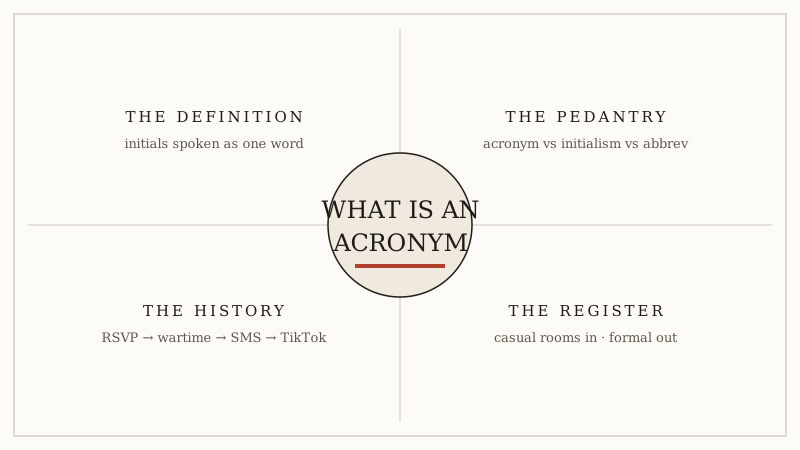
An acronym is an abbreviation formed from the initial letters of a phrase, pronounced as a single word: NASA, FOMO, scuba. The acronym meaning in one line: a phrase, compressed until it becomes a word. That last part — becomes a word — is the whole trick: an acronym succeeds when speakers stop hearing the letters and start hearing a lexical object with its own meaning, the way nobody parses "laser" as an acronym for a five-word physics phrase anymore. FOMO made that crossing in under a decade; it's now a feeling with a name, not a stack of letters.
The family is bigger than the strict definition, so here's the taxonomy once, cleanly:
- Acronym (strict): initials spoken as a word — NASA, FOMO, DEIB's cousin JEDI, scuba.
- Initialism: initials spelled out — SMH, NPC, FBI, IDK.
- Abbreviation (the umbrella, and also the misc bucket): any shortened form — "abbr." for "abbreviation," "etc." for "et cetera," "Dr." for "Doctor."
Dictionaries long ago conceded that "acronym" is used for all of the above, and this site uses it the casual way too (our section is called Acronyms, not Initialisms, because nobody searches for initialisms). But the strict line explains something real: acronyms feel like words and initialisms feel like codes, because they are — one is vocabulary, the other is notation. The test is always your mouth: if you can say it without spelling, it's an acronym; if saying it means reciting letters, it's an initialism wearing acronym clothes.
The history: from French etiquette to the group chat
The pre-internet era. Compression is old. RSVP — French, invitation etiquette, centuries old — is the genre's dignified ancestor. Military bureaucracies industrialized it (AWOL, SNAFU — the GI-era "situation normal: all fouled up," sanitized), and science government-ified it (NASA, radar). For most of the 20th century, acronyms belonged to institutions: they saved space on forms and made projects sound official.
The SMS era, 1990s–2000s. The phone keypad made compression economic. Text messages were capped at 160 characters and charged per message; typing on T9 keypads cost real seconds. Out of those constraints came the great civilian acronym bloom — lol, brb, idk, wyd, tbh, lmk — words typed by billions of people who had never been in a bureaucracy. Note what this era's acronyms carry: not space on a form but attitude in a chat — WYD is a knock on a door; TBH is a preface; SMH is a gesture.
The platform era, 2010s–now. Character limits vanished; the acronyms stayed — proof they had stopped being shortcuts and become register. The newest coinages compress culture rather than characters: IYKYK (if you know, you know) is five letters of gatekeeping; NPC (non-player character) is a whole philosophy of personhood; DEI (diversity, equity, inclusion) is a policy framework in three letters. The economy of acronym-creation has flipped: we no longer compress to save money — we compress to carry meaning more densely than spelling allows.
Why acronyms spread: the compression economy
Three engines, in historical order. Efficiency first — fewer keystrokes, fewer characters, faster coordination; the office set (LMK, FYI, EOD) still runs entirely on this rail. Economy second — the SMS pricing era left a permanent vocabulary deposit. Belonging third, and now dominant — knowing what an acronym means is a membership card, which is why the newest ones (IYKYK) are about membership itself.
That third engine explains the genre's sociology. An acronym is a gate with a word on it: insiders decode instantly, outsiders feel the gate. The lifecycle follows: coinage in a small group → spread → mainstream → the gate dissolves (everyone knows it) → a new acronym mints itself. FOMO completed that arc and graduated into ordinary vocabulary; IYKYK is mid-arc; next year's version is being typed somewhere right now by eleven people.
It also explains the emotional range the format has quietly achieved. Acronyms began as clerical shorthand and now carry the full load: judgment (SMH), romance (WYD at 1am), anxiety (FOMO), politics (DEI), contempt (NPC), etiquette (RSVP), honesty (TBH), ignorance declared without shame (IDK). Three or four letters per feeling — the compression is so complete that the abbreviation is now often the preferred register for the emotion itself. Nobody says "I am experiencing the fear of missing out"; the acronym isn't short for the feeling anymore. It's the feeling's name.
When to use acronyms (the register map)
The practical skill is matching acronym to room:
- Group chats and DMs — everything goes: wyd, tbh, smh, idk at full density. The register is casual; the acronyms are native.
- Comments and social posts — full density plus the culture-set (iykyk, npc, fomo). This is the format's natural habitat.
- Workplace chat (Slack/Teams) — the office set (lmk, fyi, eod, tbd) plus mildly social ones (tbh, idk) once the culture allows. WYD to a coworker remains a choice.
- Email and formal writing — spell out on first use, abbreviate after if needed; keep the social set out entirely unless the recipient uses it first. "SMH" in a client email is a costume, and costumes in email are remembered.
- Anything legal, medical, or safety-critical — no compression, ever. The genre's ambiguity (acronyms collide: ETA the acronym vs eta the Greek letter; DEI vs dei the Italian word) is fine in a chat and unacceptable in a contract.
The meta-rule the whole map serves: acronyms are register markers more than time-savers. Using one correctly signals the room you think you're in; using one wrongly signals it louder. When in doubt, spell it out — the extra letters cost nothing, and the wrong acronym can cost the room.
Ready to browse? Every entry in the acronyms section is spelled out, sourced, and tone-flagged — from French etiquette to the group chat's full emotional range.
Every acronyms we’ve explained
- DEI
Diversity, equity and inclusion — the workplace framework acronym that became a political flashpoint.
- FOMO
Fear of missing out — the ache of watching a moment happen without you.
- IDK
'I don't know' — the shrug, typed.
- IYKYK
'If you know, you know' — the caption that separates insiders from everyone else.
- LMK
'Let me know' — the ball is in your court, politely.
- NPC
Non-player character — the insult for someone running on rails.
- RSVP
Répondez s'il vous plaît — respond, if you please: the invitation's headcount request.
- SMH
Shaking my head — the texter's shorthand for mild disappointment or disapproval.
- TBH
'To be honest' — the preface that promises honesty, sometimes delivers it.
- TLDR
Too long; didn't read — the internet's one-line summary, or its polite shove.
- WYD
'What (are) you doing?' — texting's lowest-effort opener.
Questions people also ask
- What is an acronym?
- An acronym is an abbreviation formed from the first letters of a phrase, pronounced as a single word: NASA (National Aeronautics and Space Administration), FOMO (fear of missing out), rizz is not one (it's from 'charisma'). In casual use, 'acronym' covers letter-by-letter forms too, but the strict distinction has a name — see initialism below.
- What is the difference between an acronym and an initialism?
- Pronunciation. An acronym is said as a word (NASA, FOMO, DEIB). An initialism is spelled out letter by letter (NPC, SMH, FBI, IDK — 'eye-dee-kay'). Both are abbreviations built from initials; the test is your mouth. The distinction is beloved of pedants and ignored by everyone else — dictionaries now accept 'acronym' as the umbrella term — but it explains why some letter-clusters feel like words (fomo) and others like codes (smh).
- Is RSVP an acronym?
- Technically an initialism (arr-ess-vee-pee), taken from the French 'répondez s'il vous plaît' — respond, if you please. It's also the oldest acronym-family item most people use weekly, borrowed from French invitation etiquette centuries before texting existed. RSVP is the proof that compressing phrases into letters is not an internet invention — it's a French one.
- Why do people use acronyms?
- Three engines: speed (typing 'smh' is faster than the phrase it carries), cost (early SMS charged by the character — lol, brb and idk are partly economic artifacts), and belonging (knowing what IYKYK means is a membership card). The first two explain why acronyms exist; the third explains why they spread — compression is also a gate.
- Are acronyms professional?
- It depends on the acronym and the audience. Office-native ones (FYI, EOD, LMK in chat) are professional by adoption. Social-native ones (SMH, WYD, IYKYK) stay casual — in email to a client they read as a costume. The safe rules: spell out anything the reader might not know, match the register of whoever wrote last, and never let the acronym do tonal work the sentence should do.
- What does it mean when an acronym becomes a word?
- It has fully crossed over — people use it without thinking of the letters, and sometimes without knowing them. 'Laser' (light amplification by stimulated emission of radiation), 'scuba' (self-contained underwater breathing apparatus) and 'AWOL' are acronyms that graduated into ordinary vocabulary. FOMO is halfway there; SMH — spoken letter by letter — is not going anywhere, because the letters ARE the gesture.
Browse every acronyms entry in the acronyms section.