TLDR Meaning
acronyms · practical, can read as dismissive · updated 2026-11-04
Too long; didn't read — the internet's one-line summary, or its polite shove.
What does TLDR mean?
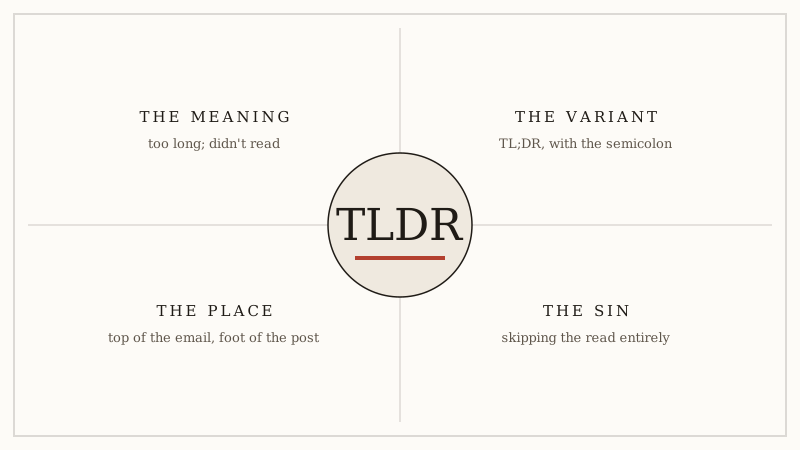
TLDR stands for "too long; didn't read." It is the internet's compression tool — four letters that mark a short summary of a long text. The TLDR meaning in one line: the bottom line, stated first. An author writes a wall of text and stamps "TLDR: launch moves to Friday" at the top; a reader who skipped the wall replies "TLDR" to say they didn't read it at all.
What makes TLDR unusual among acronyms is that it works in two opposite directions, and you have to read the room to know which one you're getting. As an author's tool, it is a courtesy — the considerate summary that respects busy readers. As a reader's retort, it is a dismissal — your two thousand words just got declined in four letters. Same spelling, opposite energies. No other acronym in common use does both jobs, and this double life is the single most important thing to understand about it.
The second job has quietly become respectable. "TLDR" sections now sit at the top of corporate newsletters, engineering docs and product updates — the format has been institutionalized so thoroughly that not summarizing a long update can read as the ruder choice. The word completed its journey from forum heckle to workplace convention without ever changing its letters.
Where TLDR comes from
TLDR was born in the early-2000s forum era, as a reply to walls of text: a user would skim or skip a long post and announce "TL;DR" — too long; didn't read — sometimes followed by a guess at the contents, usually as a taunt. The semicolon in the original spelling preserves the phrase's own punctuation: too long; didn't read is two clauses, and the forum generation kept the semicolon the way you keep a birthmark.
From forums it spread to Reddit, where the author's-job version developed: posters began appending their own "TL;DR" at the bottom of long submissions, then placing it at the top once the convention matured. Newsletters, wikis and workplace docs standardized the summary form through the 2010s; Slack and Teams flattened the semicolon out, and by the 2020s "TLDR" at the top of a company-wide email was simply good manners.
The arc is worth appreciating: a heckle became a courtesy without ever changing its letters. That inversion is the word's whole biography — and the reason "is TLDR rude?" has no one-line answer.
The two jobs of TLDR
Job one: the author's summary. You wrote something long; you owe the skimmers a door. "TLDR: the trip is cancelled, refunds by Friday." This TLDR is a kindness, and in work contexts it is close to mandatory — engineering docs, product updates and policy emails routinely open with one. The craft rules are simple: it must be genuinely short (one to three sentences), genuinely complete (a person who reads only it should not be misled), and placed where the skimmers are (top for work, bottom for forums).
Job two: the reader's shrug. You received something long; you decline it. "TLDR" as a reply says: too long, didn't read, no regrets. Among friends under a 500-word story about someone's sourdough starter, this is affectionate heckling. In an argument, it is a weapon — it refuses the other person's words while claiming the win, which is why it so reliably escalates. The asymmetry is built in: the author spent an hour, the dismissal cost four letters.
Knowing which job a TLDR is doing is the entire skill. When you see it in the wild, ask: did the writer of this long text also write this TLDR? If yes — summary, courtesy. If no — you are watching a dismissal, or banter aimed at one.
TL;DR or TLDR?
Both spellings are correct, and the semicolon is the older form — it preserves the two-clause structure of the phrase itself (too long; didn't read), which is why forum natives and Reddit history buffs keep it. "TLDR" is the normalized modern form: no punctuation, faster to type, now the default in workplace prose.
The one real rule is consistency within a document. A doc that opens with "TLDR:" and later says "TL;DR:" looks like two authors and no editor. If you must choose blind, "TLDR" is the safer modern default; if you're posting in forum-flavored spaces, the semicolon version signals you know the word's history — a small flex, but it reads.
Placement has conventions too: work docs put the summary at the top (decision-makers skim), while forum posts traditionally put it at the bottom (where the full read is presumed). Putting a TLDR at the bottom of a work email makes readers hunt for it; putting it at the top of a Reddit story spoils your punchline. Location is tone.
When to use it (and when not to)
TLDR fits anywhere long text meets busy readers:
- work updates, engineering docs and announcements — a top-of-post summary is a courtesy
- long forum posts and Reddit stories — bottom-of-post TLDR honors the format's history
- newsletters and announcements — "TLDR" sections are now a standard genre
Keep it out of these places:
- sensitive conversations — "TLDR" in front of an apology or a hard personal message says the details were the disposable part
- arguments — as a reply, it refuses the other person's words and escalates every time
- texts to one person — if a friend needed 200 words, replying "TLDR" tells them their crisis needed an editor
Examples in the wild
"TLDR: launch moves to Friday, refunds processed by Monday, details below."
"TLDR, but did you two get back together?? I need the ending."
"He replied 'tldr' to my paragraph. Four letters. I typed 300 words and he answered with four letters."
"TL;DR at the bottom because the story earns it: we didn't buy the boat."
Notice the range: a corporate courtesy, an honest skip, a wound, and a joke. Same four letters in every line — the direction is the meaning. That's the fastest way to teach the acronym to someone: TLDR is not a word with a definition; it is a tool with two handles, and you judge it by which handle the person grabbed.
Is TLDR rude?
As a summary, never — it is a service the author performs for the reader. As a reply, it is contextually rude: aimed at a friend's essay it is banter, aimed at a stranger's argument it is a refusal to engage that claims victory anyway, aimed at something emotional it is a small cruelty dressed as brevity.
The deep reason replies feel rude: a TLDR reply costs nothing while the message it dismissed cost effort. dismissing in four letters what someone built in two thousand is an asymmetric move — which is exactly why it wins flame wars and loses friends. The house rule: TLDR your own texts (as summaries, always), never someone else's feelings.
How people get TLDR wrong
First, the fake summary — a "TLDR" that runs five paragraphs or omits the decision. A TLDR is a door, not a hallway; if skimmers can't act on it alone, it failed its one job.
Second, the confident skip: replying to a long message without reading it, guessing at its content, and being wrong. The genre of "TLDR but here's my opinion anyway" is internet comedy at this point — dismissing the read while needing the read.
Third, register errors in both directions. TLDR in a sympathy message treats grief as length; no TLDR in a 3,000-word org update treats everyone's afternoon as your draft budget. Match the tool to the room.
How TLDR relates to SMH, FOMO and RSVP
TLDR belongs to the acronym family that carries whole social moves in a few letters:
- SMH is the judgment version of compression — a head shake you can type, usually right after the story it disapproves of.
- FOMO compresses a feeling — the ache of missing out. TLDR compresses an act (the reading); FOMO compresses an emotion.
- RSVP compresses a demand — respond, if you please. It is the only one of the family born in etiquette rather than laziness, and the only one whose reply you're required to give.
- DEI is the formal cousin from a different floor of the building — diversity, equity and inclusion. Where TLDR compresses a paragraph, DEI compresses an entire policy framework.
Four letters each, four different jobs: tldr summarizes, smh judges, fomo aches, rsvp demands. Compression is the family business; the goods differ.
Related acronyms
- SMH
Shaking my head — the texter's shorthand for mild disappointment or disapproval.
- FOMO
Fear of missing out — the ache of watching a moment happen without you.
- RSVP
Répondez s'il vous plaît — respond, if you please: the invitation's headcount request.
- DEI
Diversity, equity and inclusion — the workplace framework acronym that became a political flashpoint.
Questions people also ask
- What does TLDR stand for?
- TLDR stands for 'too long; didn't read.' It marks a short summary of a long text — the author's version at the top of a post, or the reader's version announcing they skipped it. Both jobs use the same four letters.
- Is TLDR rude?
- As a summary label, no — it is a courtesy. As a reply, it can be: 'TLDR' sent in response to someone's message says their words weren't worth the read. The letters don't change; the direction does.
- How do you use TLDR in a sentence?
- As a summary marker: 'TLDR: we're moving the launch to Friday' at the top of a long update. As a reaction: 'TLDR, but did you two get back together?' As an adjective, informally: 'that meeting was so tldr.'
- TLDR vs TL;DR — which is correct?
- Both are accepted. TL;DR (with the semicolon) is the older, forum-native spelling and mirrors the phrase's punctuation; TLDR is the normalized modern form. Same meaning, same tone — pick one and stay consistent.
- What does it mean when someone replies TLDR to your post?
- Literally, that they didn't read it — usually because it was long. Read the room: sometimes it's an honest note that your post needed a summary; in an argument it's a dismissal; from a friend under your essay it might just be banter.
New here? Start with the acronyms guide — what acronyms are and where the readings come from.