Cooked Meaning
slang · alarm or laughter, caps-dependent · updated 2026-11-04
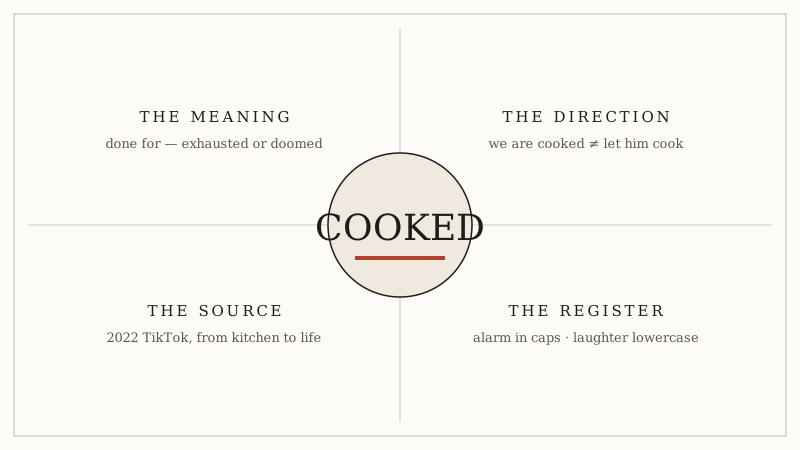
Done for — exhausted, doomed or exposed, depending on the caps.
What does cooked mean?
Cooked means done for. The cooked meaning in one line: finished — exhausted, doomed or exposed — with the heat already applied and no take-backs. The kitchen metaphor carries the whole range: a person can be cooked (spent), a plan can be cooked (doomed), an argument can get you cooked (destroyed), and a phone at 2% is definitely cooked. Whatever went into the heat came out finished, and the word is the receipt.
What makes cooked distinct in the slang ecosystem is its dual register. At full volume — "WE'RE COOKED," all caps, repeated — it's genuine alarm, the modern "we're doomed." At lowercase — "bro is cooked lol" — it's comedy: the doom is real but the mood is recreational, and the speaker is enjoying the disaster the way people enjoy weather. Few slang words toggle so completely between sincerity and bit, and fluent users switch between the two within a single conversation.
It's worth knowing what cooked is not. It's not "drunk" or "high" — Australian slang does use cooked that way ("he was cooked last night"), and the meaning is findable in the wild, but the dominant global usage since 2023 is the doom/exhaustion sense. It's not gradual: cooked is a completed state, not a process (the process is "cooking"). And it's not a synonym for tired — tired recovers by morning; cooked implies the heat has changed the protein.
Where cooked comes from
Two older streams, one TikTok flood. The Commonwealth stream is decades old: Australian and British slang used "cooked" for exhausted ("after that shift I'm cooked") and for ruined or broken ("the engine's cooked") — a sturdy regionalism with none of the internet's irony. The hip-hop stream runs parallel: "cook" as making heat — cooking up tracks, cooking the competition — which by the 2010s gave us the encouragement form "let him cook" and its family ("he's cooking," "cook with the sauce").
The streams fused on TikTok around 2022–2023, in the dread-humor era — the genre that processes bad news (economy, climate, exam results, the group project) as shared entertainment. "We're cooked" turned out to be the perfect caption for that mood: catastrophic in content, joking in tone, endlessly applicable. It went global at speed, attaching to sports collapses, tech layoffs, minor personal disasters and geopolitical headlines with equal enthusiasm.
By 2024–2025 the word had completed the standard circuit: peak saturation, parent comprehension, brand attempts. But cooked has proven stickier than the average meme word — like "aura," it's a verdict word, and verdict words regenerate their own content forever. Every day produces new things that are, regrettably, cooked.
The cooked spectrum: from let him cook to fully cooked
The kitchen has a full grammar, and the words are related but not interchangeable:
- "Let him cook" — encouragement. He's mid-process and it might be brilliant; do not interrupt. Origin: hip-hop, cooking as making heat.
- "He's cooking" — the process is visibly working. On a roll, in the zone, producing.
- "It's cooked" / "I'm cooked" — the finished state, negative: done for, spent, ruined. From the Commonwealth sense — through the heat, out the other side.
- "We're cooked" — collective doom, plural, grinning. The word's flagship form since 2023.
- "He got cooked" — the head-to-head destruction sense, straight out of sports and gaming commentary: the defender got cooked on that ankle-breaker, the mid got cooked in lane, the debater got cooked in the replies. One-on-one, there's a winner (the cook) and a finished product (the cooked).
- "Am I cooked?" — the interrogative genre: posting your situation so the comments can deliver the verdict. (The comments always say yes. That's the service they provide.)
The arc is the point: one thread can run the full spectrum — "let him cook," "he's cooking," "uh oh," "he's cooked," "WE'RE ALL COOKED" — and the vocabulary narrates the whole rise and fall like a nature documentary about a soufflé.
When to use it (and when it stings)
Cooked fits the whole casual range — verdicts, exhaustion, doom-laughter:
- post-workout, post-exam, post-airport-day: "I am fully cooked"
- live sports and gaming collapses: "the coach is cooked, the season is cooked, we're cooked"
- the dread-humor bit: "read one (1) news headline. we're so cooked"
The word's failure modes are tonal. Used about someone else's genuine disaster — a friend's job loss, a stranger's accident — "they're cooked" flips from funny to callous, because the joke's foundation is the recreational attitude toward doom, and not everyone's doom is recreational yet. Timing rule: a disaster is cookable when its owner is laughing; until then, bring casseroles, not captions. And in serious rooms (managers, medics, your grandmother), "cooked" reads as flippant — the word cannot say "gravely concerned" and doesn't pretend to. The same rule covers the head-to-head sense: "got cooked" between friends after a game is banter; "got cooked" aimed at someone who wasn't playing is just an insult with a scoreboard.
Examples in the wild
"interview was at 9, I woke at 9:15. cooked. fully cooked. preheated even."
"they're up 3-0 with two minutes left. we are COOKED. WE ARE COOKED."
"my sleep schedule is cooked, my budget is cooked, but my delulu is thriving so it balances."
Notice the grammar: cooked arrives in two speeds — lowercase past-tense verdicts ("cooked. fully cooked.") and all-caps present-tense emergencies ("WE ARE COOKED"). The third example shows the standard 2025-26 ecosystem pairing: cooked (the audit) + delulu (the response). The vocabulary has quietly built a complete emotional pipeline — the verdict, the appeal, and the coping mechanism — and a generation is running it in real time.
How people get cooked wrong
Three recurring mistakes. First, tense confusion — "I'm cooking" to mean done-for; cooking is the process, cooked is the verdict, and the difference is the entire meaning. Second, misreading the register — using "we're cooked" in a genuinely grave situation (a diagnosis, a layoff meeting) where the comic frame insults the gravity; the word is a grin, and grins have an address. Third, the regional overwrite — assuming cooked means drunk/high globally because Australian slang says so; the dominant international sense is doom/exhaustion, and the drinking sense needs its context flagged.
How cooked relates to aura, delulu, sigma and mogging
Cooked sits in the verdict wing of this site's slang family — the words that deliver rulings:
- Aura is the ledger; cooked is its worst posting. "−1000 aura" is a fumble; "cooked" is the account closed.
- Delulu is the appeal process — the standard response to being cooked is selective belief, and the ecosystem runs on the pairing.
- Sigma is the persona that claims immunity ("sigmas don't get cooked"), which the comments correctly read as farming.
- Mogging is the force that cooks others — presence used as a weapon; cooked is the state of the mogged.
The family map: cooked is the verdict, aura the scoreboard, delulu the coping, mogging the weapon. If the meaning of cooked could be reduced to one line: done for, and laughing about it — the only doom the internet can say out loud, because the word is already smiling.
Related slang
Questions people also ask
- What does cooked mean in slang?
- Cooked means done for — finished, exhausted, doomed or exposed, depending on context. 'I'm cooked' after a shift means spent; 'we're cooked' about the group project means doomed; 'he got cooked' in an argument means destroyed. The kitchen metaphor does all the work: something that has been through the heat and come out finished.
- What does 'we're cooked' mean?
- The plural-dread version: the situation — the team, the group chat, society, the planet — is beyond saving and everyone knows it. It's the number-one form of the word since 2023, used for everything from a 3-0 deficit to climate headlines, always with a grin. 'We're cooked' is despair with good posture: the doom is acknowledged and the mood stays recreational.
- What's the difference between cooked and 'let him cook'?
- Opposite directions of the same kitchen. 'Let him cook' means keep going, he's onto something — cooking as in preparing something good. 'Cooked' means the dish is beyond saving — done, ruined, finished. Someone can go from 'let him cook' to 'he's cooking' to fully 'cooked' in one thread, and the vocabulary tracks the whole arc.
- Is cooked positive or negative?
- Mostly negative with a comic overlay — 'cooked' is rarely tragic in tone, even when the news is bad. The one borderline-positive use is exhaustion ('that workout cooked me'), which is a boast wearing a complaint. Tone check: caps and repetition mean alarm; lowercase means laughing about it.
- Where did cooked slang come from?
- Two streams merged. Australian and British slang has used 'cooked' for exhausted or ruined for decades ('I'm cooked, mate'), and hip-hop used 'cook' for making heat — cooking up verses — which gave us 'let him cook' in the 2010s-2020s. TikTok fused both in 2022-2023: 'we're cooked' became the standard caption for dread-humor content and jumped worldwide.
- What does cooked mean on TikTok?
- On TikTok, cooked is the verdict label — the caption under fails, collapses, bad news and self-inflicted disasters, meaning 'it's over.' The platform also runs the positive cousin ('he's cooking' = he's on a roll) and the meme essay-format 'am I cooked?' posts asking the comments to judge a situation. TikTok is where the word lives fullest: half status report, half punchline.
New here? Start with the slang guide — what slang are and where they come from.