Sigma Meaning
slang · ironic; a joke about a worldview · updated 2026-11-04
The lone-wolf rank — 'alpha, but alone,' now mostly an ironic meme.
What does sigma mean?
Sigma, in current slang, means the lone wolf — the person (usually a man, by default framing) who has all the alpha's spoils but none of the alpha's obligations: successful, self-directed, romantically viable, and pointedly outside the social ranking system everyone else is stuck in. The sigma meaning in one line: "alpha, but alone — and proud of it."
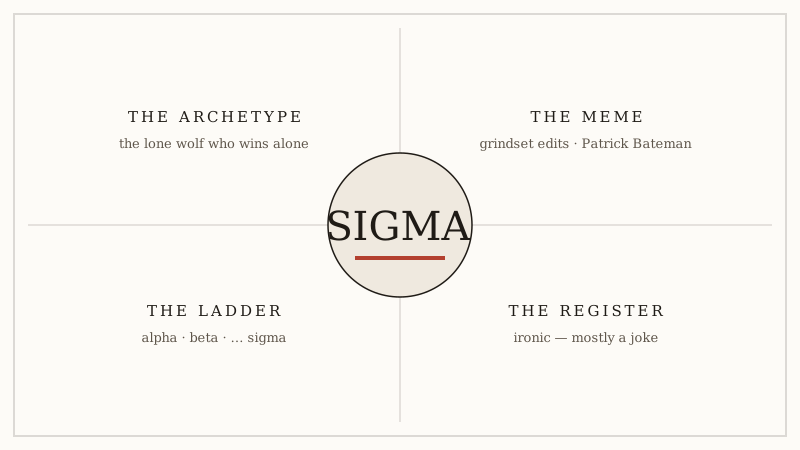
The word's history is a two-act play, and you need both acts to use it correctly today. Act one (2010–2020): a sincere coinage inside manosphere and pickup-artist circles — a new rung added to the "socio-sexual hierarchy" so that certain men could rank themselves above the hierarchy instead of losing in it. Act two (2021 onward): the internet found act one, found it hilarious, and turned "sigma" into an ironic meme format — Patrick Bateman edits, sigma grindset parody, "Literally me" characters — until the sincere usage became the punchline.
So when someone says sigma in 2026, the base-rate assumption is irony: a joke about lone-wolf self-mythology. Sincere usage survives in the corners where the word was born, and the two modes are distinguishable by tone of voice alone — which is the word's whole party trick.
It's worth saying what sigma is not. It's not the Greek letter's technical uses (statistics, physics, frat names — context separates those instantly). It's not a real taxonomy — the "socio-sexual hierarchy" has the scientific standing of a horoscope with a gym membership. And it's not an insult, exactly: ironic sigma is affectionate teasing, aimed at the archetype more than the person.
Where sigma comes from
The paper trail is clear and slightly embarrassing, which is part of why the meme works. The "socio-sexual hierarchy" — alphas, betas, and a supporting cast of Greek letters — was popularized in 2000s pickup-artist forums as pseudo-science for ranking men. In 2010, the far-right blogger Vox Day wrote the post that added sigma: the "lone wolf" outlier who sits outside the hierarchy and is the only type the alpha has reason to fear. The claim was earnest; the audience was small.
For a decade sigma stayed niche — manosphere vocabulary, invisible to the mainstream. Then 2021 happened. Meme pages discovered the hierarchy's absurdity, and sigma became the perfect ironic character: Patrick Bateman (American Psycho) doing his morning routine to phonk music, Thomas Shelby (Peaky Blinders) smoking in silence, John Wick, Ryan Gosling's entire filmography (Drive, Blade Runner 2049) — the "Literally me" cinematic universe. The edits were joking. The comments were half-joking. The word went supernova.
Since then it has followed the standard slang route: TikTok Gen Alpha absorbed it as a general-purpose "cool/funny" sound (fused with brainrot characters — the "sigma" kid is a stock figure now), brands tried it, parents learned it. The sincere manosphere usage continues in its original habitat, now permanently overlaid with a laugh track the speakers can hear too.
What calling someone sigma actually claims
Strip the irony down and the word makes three claims at once:
- Self-sufficiency — needs no one's approval, builds alone, eats alone, wins alone. The sigma's kitchen table seats one, by choice.
- Outsider advantage — participates in society's games but not its league tables. Money and competence without the networking.
- Effortless pull — in the original hierarchy, sigmas attract without pursuing (an ancestor of "unspoken rizz," which the memes eventually made explicit).
The irony layer works because the claims are unfalsifiable in a specific way: any behavior can be re-read as sigma. Alone on Friday? Sigma. Busy all week? Sigma grindset. Rejected? Outside the hierarchy anyway. A label that cannot lose is a label that cannot mean anything — and the memes know this, which is why the genre's real subject is the audience: the guys watching Bateman edits and thinking "finally, someone understands me."
That's the actual social function of ironic sigma: it lets a generation of lonely, ambitious, terminally online young men talk about loneliness and ambition through a character sheet. The meme is a joke the way a clown show at a funeral is a joke — technically.
When to use it (and when not to)
Sigma fits meme speech and gentle teasing:
- ironic self-description after a solitary win: "wrote 2,000 words alone on a Friday night. sigma."
- rating fictional characters: "Thomas Shelby is peak sigma"
- the grindset bit: "sigma rules: never explain, never apologize, always hydrate"
The word's failure modes are all register errors. Don't use it sincerely as a self-description on a dating profile unless you want your screenshot in a group chat — the sincere sigma is the meme's designated victim. Don't use it to console someone actually struggling with isolation ("you're such a sigma") — the joke requires the person to be in on it. And don't deploy it on anyone over 30 without a translator; to them you are saying Greek.
Examples in the wild
"declined the invite, went to the gym at 11pm, ate chicken and rice in the car. sigma season."
"my man watched one Bateman edit and decided he's a sigma now. brother you cried at the Honda dealership."
"new guy at work says nothing, closes tickets, leaves at 5. sigma or just normal? discussing."
Notice the grammar: sigma statements are third-person captions on solitary behavior. The person narrates their own actions like a nature documentary — "sigma season," "sigma activities" — because the joke only works in voiceover mode. The moment it becomes a live first-person claim ("I am a sigma"), the bit dies and everyone at the table becomes a witness.
How people get sigma wrong
Three recurring mistakes. First, taking the hierarchy as real science — it's fan fiction about wolf packs (themselves misdescribed; actual wolf packs are mostly families) applied to humans. Second, missing the irony register and thinking the 2021+ meme wave was sincere admiration — the memes are laughing at the self-image even while genuinely enjoying the characters. Third, the fatal one: calling yourself sigma out loud, sincerely. The word's own rules make this a forfeit — a real lone wolf doesn't announce the paperwork. The internet agreed on this instantly, which is the closest thing slang has to case law.
How sigma relates to rizz, mogging and chud
Sigma sits in the manosphere-adjacent wing of this site's slang family — the words born in or near the ranking-people economy — and the neighbors sharpen its edges:
- Rizz is the skill sigma mythology claims comes free: the lone wolf attracts without pursuing. The memes cross-pollinate constantly ("unspoken rizz" is sigma's love language).
- Mogging is the hierarchy at its most brutal — outshining someone so completely they shrink. Sigma is the fantasy of exiting that contest; mogging is the contest.
- Chud is what the hierarchy's critics look like from the other side — a political insult, but a cousin document of the same online gender-war ecosystem.
- Gyatt is the reaction word from the same creator economy (Kai Cenat's orbit) that helped push sigma meme-ward — the loud id to sigma's quiet superego.
The family map: sigma is the self-image, rizz the claimed skill, mogging the contest it fantasizes about exiting, gyatt the unguarded reaction. If the meaning of sigma could be reduced to one line: the lone wolf rank — a joke about a worldview, told by the people half-living in it.
Related slang
- rizz
Charisma, compressed — the skill of attracting without seeming to try.
- mogging
Outshining someone on sight — gym slang for dominating the looks comparison.
- gyatt
A yelled 'goddamn' — the Twitch reaction that became Gen Alpha slang.
- chud
The internet's monster-movie insult for an unkempt, reactionary poster.
Questions people also ask
- What is a sigma male?
- In the internet's pseudo-biology, a sigma male is a lone wolf: a man who has the alpha's success — money, competence, desirability — but operates outside the social hierarchy entirely, answering to no one. He's the 'lone wolf' to the alpha's 'pack leader.' Coined sincerely in 2010, it lives today almost entirely as a joke.
- Who created the sigma male concept?
- The term traces to a 2010 blog post by Vox Day, a far-right writer, who inserted 'sigma' into the pseudo-scientific 'socio-sexual hierarchy' made famous by pickup-artist forums. It stayed niche for a decade, then exploded in 2021 when meme pages turned it into ironic content — Patrick Bateman edits, 'sigma grindset' parody, and so on.
- What is a sigma female?
- The female version of the same archetype: a self-sufficient woman who opts out of the social competition — independent, unbothered, hard to read. It appeared as the meme spread and is used both sincerely (self-descriptions, dating profiles) and ironically, same as the male version, with the same tells.
- Is sigma a compliment?
- Sincerely meant, it's meant as one — the highest tier, 'outside the game.' Ironically meant (the dominant mode since 2021), calling someone sigma is teasing them for taking the hierarchy seriously at all. The tell is the face: if the speaker is smiling, it's a joke; if not, they're in character, which is also kind of the joke.
- What does sigma grindset mean?
- A parody phrase — 'grindset' = grind + mindset — mocking hustle-bro self-improvement content. Sigma grindset memes pair absurd 'discipline' advice (wake at 4am, eye contact with the sun) with lone-wolf imagery. The joke is the genre, not the advice: nobody unironically uses the phrase who isn't about to be quoted in a screenshot.
- Why is everyone saying sigma?
- Because it peaked as an ironic meme format in 2021–2024 and hasn't fully left — the 'Literally me' character edits (Patrick Bateman, Thomas Shelby, John Wick, Ryan Gosling roles) keep recycling it. On TikTok it also fused with brainrot content for Gen Alpha, where 'sigma' is just a funny sound meaning 'cool loner.'
New here? Start with the slang guide — what slang are and where they come from.