What Is Slang?
slang guide · updated 2026-11-04
In-group language at full speed — coined, spread, retired before dictionaries notice.
The definition
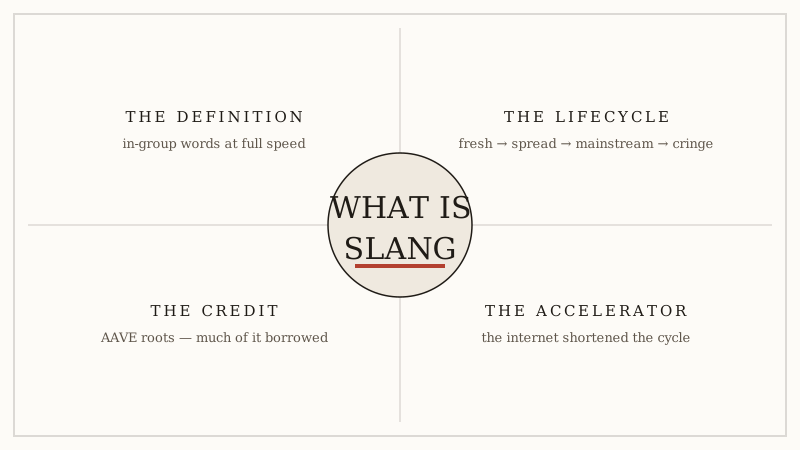
Slang is in-group language at full speed: vocabulary coined, spread and retired by communities faster than dictionaries — or outsiders — can track. The slang meaning in one line: membership badges made of words. A word like rizz or cooked carries two payloads at once: its literal content (charisma, done-for) and its social content (I'm current; I run with people who know this). That second payload is the actual product — slang is language wearing a lanyard.
Three properties define the genre. First, informality by design — slang chooses the vivid register over the careful one (that's its charm and its risk; "gyatt" at a wedding is a category error). Second, expiry — unlike ordinary words, slang dies of success: the moment your principal says it, it's finished (see: rizz, which went from streamer in-joke to Oxford's Word of the Year to certified dad-vocabulary in roughly three years). Third, borrowing without receipts — slang crosses community borders constantly, and the trail of credit is often lost in transit, which brings consequences we'll deal with honestly below.
What slang is not: it isn't "bad grammar" (slang rides on top of perfectly grammatical speech), it isn't jargon (jargon excludes outsiders by complexity; slang bonds insiders by shared currency), and it isn't new — every generation is at least the fiftieth to invent it. What is new is the speed.
The lifecycle: how a slang word lives and dies
Slang words run a remarkably consistent arc, and knowing the stages is the difference between fluent and cringe:
- Coinage — a small group mints it: a streamer's bit (gyatt from Kai Cenat's orbit), a subculture's shorthand, a community's joke (delulu from K-pop stan Twitter).
- Spread — the word crosses to adjacent communities, usually via one high-bandwidth carrier (a TikTok sound, a meme format, a rapper's verse). This is the word's peak utility: current enough to signal, common enough to be understood.
- Mainstreaming — brands tweet it, parents ask about it, dictionaries shortlist it. The badge is now counterfeit; the originators are already miles downstream. (The trophy phase: rizz winning Word of the Year 2023 was simultaneously the word's coronation and its funeral.)
- Cringe — sincere use by the outgroup marks the user as behind. The word enters its irony-only period.
- Nostalgia — a few years on, the word returns as a period detail ("remember when we all said 'on fleek'?"), quoted with affectionate air quotes, forever.
The internet compressed this cycle from decades to months, which is why a word can be born, peak, die and get nostalgic tribute banners within a single school year. The words this site documents are at every stage of the arc — that's deliberate: a dictionary that only covers current words is always a season behind; one that documents the whole lifecycle stays useful.
Where slang actually comes from
The engines are few and well known, and the biggest deserves its name said plainly:
AAVE — the largest single source. African American Vernacular English has been American slang's primary engine for over a century: jazz-era vocabulary, cool, woke, tea, cap/no cap, and streams of current vocabulary, much of it crossing into general (and white) use through music and social platforms, often without credit. The fair framing this site uses: the borrowing itself is how language has always worked; the erasure is the optional part, and we don't do it — when a word's documented origin is a community, the entry says so.
Subcultures. Drag ballroom culture gave mainstream English slay, shade and reading (as in: fundamental). Gaming gave NPC, AFK, nerf. Stan culture gave delulu, bias, comeback. Skate, finance-meme, and prison/military vocab fill other veins. Each subculture's words arrive pre-loaded with its values — scorekeeping (aura), performance (larps), dominance (mogging).
Creator platforms — the new engine. Twitch and TikTok changed the physics: one streamer's reaction word used to reach a neighborhood; now it reaches a continent in a weekend. The newest entries in any slang dictionary are increasingly platform-native coinages — rizz, gyatt — born on stream, spread by algorithm.
Older regional speech. Not everything is internet-fresh: cooked (exhausted/ruined) rode decades of Australian slang before TikTok globalized it. Regional vocab is slang's deep reservoir — the internet mostly amplifies and redistributes it.
Tone: the skill this site actually teaches
Here is the thing every slang entry on this site exists to say: vocabulary is the easy 20%. The other 80% is tone — knowing what a word carries, not just what it means. Gyatt is a catcall that can pass as a meme; the aim decides. Chud is an insult that ends conversations efficiently and wins none. Sigma is a joke that stops being one the second you say it sincerely. Calling yourself delulu is charming; calling someone else delulu is a dismissal with a smile.
Every entry in the slang section carries a tone flag in its header — playful, political, thirsty, edgy — and a "when to use it" section with the rooms where it lands and the rooms where it detonates. That's the site's actual product: not a word list, but the social physics around the words. Slang is a knife-set drawer; we label the blades.
The last word on keeping up: don't chase — decode. Fluency-by-chasing is how 40-year-olds end up saying "no cap" at teenagers, which is the circle of life running backwards. When a word surfaces, look it up, note the tone, and deploy only when the room is right. A current dictionary beats a current vocabulary — the dictionary knows all the rooms.
Every slang we’ve explained
- aura
Presence you can score — the points system for cool.
- chud
The internet's monster-movie insult for an unkempt, reactionary poster.
- cooked
Done for — exhausted, doomed or exposed, depending on the caps.
- delulu
Delusional, made cute — the stan word for your wildest hopes.
- egma
A tightened-up enigma — someone mysterious, hard to read, a little intriguing.
- gyatt
A yelled 'goddamn' — the Twitch reaction that became Gen Alpha slang.
- larps
The internet's word for playing a role instead of being real — pretending, not living.
- mogging
Outshining someone on sight — gym slang for dominating the looks comparison.
- rizz
Charisma, compressed — the skill of attracting without seeming to try.
- sigma
The lone-wolf rank — 'alpha, but alone,' now mostly an ironic meme.
Questions people also ask
- What is slang?
- Slang is informal vocabulary that signals group membership — the words a community uses among itself that outsiders don't fully command: new coinages (rizz), repurposed old words (cooked), and playful spellings (delulu). Its defining features are speed and expiry: slang is the fastest-moving layer of any language, and that's by design — once everyone understands a word, it stops doing its job.
- What is the difference between slang and dialect?
- A dialect is a full language variety — its own grammar, accent and vocabulary, spoken by a community natively (AAVE, Scottish English, Singlish). Slang is a vocabulary layer that sits on top of any variety — you can use slang inside any dialect. The confusion matters politically: much internet 'slang' is actually vocabulary borrowed from AAVE, a dialect — treating a community's native speech as 'just trendy words' is a real error with real history behind it.
- Where does slang come from?
- The same few engines, repeatedly: AAVE (the single largest source of American slang for a century), immigrant and multilingual communities, subcultures (drag ballroom, skate, hip-hop, gaming), institutions (military, prison, schools), and — the newest engine — creator platforms like TikTok, where a streamer's in-joke can reach a hundred million ears in a weekend.
- Why does slang change so fast?
- Because its value is exclusivity. Slang works as a membership badge only while it's current; once parents and brands pick it up, the badge is counterfeit and the in-group mints a new one. That arms race — adopt, saturate, replace — is the lifecycle, and the internet compressed it from decades to months. A word like rizz went from niche to Oxford Word of the Year to dad-joke status in about three years.
- Is all slang from AAVE?
- Not all, but a remarkable share of the most successful American slang is — from jazz-era words through 'cool' and 'woke' to current vocabulary — and the borrowing is often uncredited. The fair rule this site follows: describe where words actually come from, credit the communities that coined them, and note that using the words is fine while mocking the speakers is not. Slang travels; respect should travel with it.
- How do I keep up with slang?
- You don't, fully — that's the design. The practical move is a decode-on-demand system: when a word surfaces, look it up (that's what this site is for), note the tone flag, and use it only if the room is right. Fluent slang use is 20% vocabulary and 80% knowing when not to — a dictionary beats a trend-chasing habit every time.
Browse every slang entry in the slang section.