Gyatt Meaning
slang · loud; thirsty; risky at work · updated 2026-11-04
A yelled 'goddamn' — the Twitch reaction that became Gen Alpha slang.
What does gyatt mean?
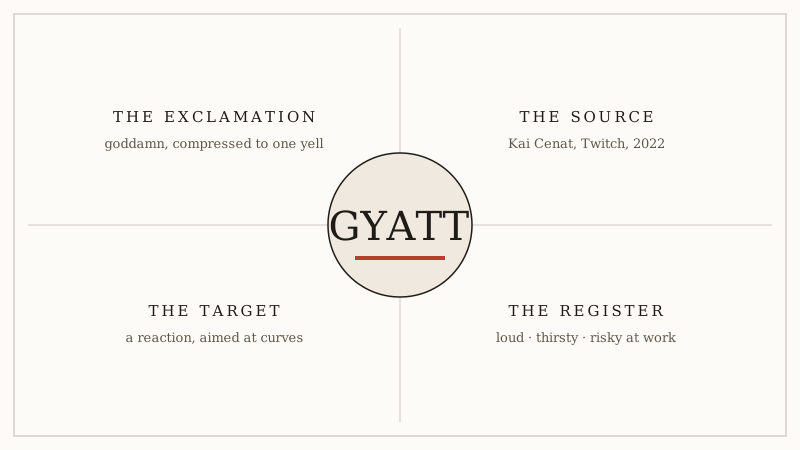
Gyatt is "goddamn" yelled into one syllable. The gyatt meaning in one line: the sound of shock at a dramatic figure — a gasp with an engine. It's an exclamation, not a description: the word doesn't say anything about the person or thing that caused it, it just reports the speaker's system crash. Someone curvy walks by, something unbelievable happens, and the witness produces a loud, mangled "GYATT" — the linguistic equivalent of a car horn.
The word is Gen Alpha's most exportable exclamation, and its spread follows a pattern worth noticing: a reaction sound born on Twitch (adult streamers, adult chaos) migrated downward into middle-school hallways, where kids use it semi-abstractly — at snacks, at grades, at each other's Minecraft builds — with the original meaning half-forgotten but never actually gone. Parents hear it and sense correctly that it's slightly loaded; kids hear it and mean "whoa" with extra steps. Both readings are accurate, which is the interesting part.
It's worth being clear about what gyatt is not. It's not a noun for a body part, however much the internet enjoys using it that way in captions ("that gyatt is unreal") — that's the exclamation being recycled as a noun, the way "damn" became a noun in "giving a damn." It's not an acronym, despite backronym attempts. And it's not neutral: even in its broadened use, the word carries a strand of thirst that "whoa" doesn't, and users above the age of twelve should know that strand is always audible.
Where gyatt comes from
The origin is documented and recent. The word comes from the orbit of Kai Cenat — the same Harlem streamer ecosystem that produced "rizz" (gyatt came from his friend's vocabulary, per Cenat's own interviews) — and exploded through his 2022 Twitch streams, where a curvy presence on screen (a guest, a video, a passerby) would trigger a full-body "GYAATT" reaction, complete with the collapse into the chair. Other streamers — YourRage is frequently credited alongside — amplified it, and TikTok clipped it into the atmosphere.
From there the standard slang pipeline ran fast, with a twist: gyatt didn't go up into adult mainstream vocabulary the way rizz did — it went down into Gen Alpha. By 2023–2024 it was a staple of school hallways and Roblox voice chat, loosened from its original context into a general yell of amazement. That downward drift is the word's defining sociology: adults coined it, children inherited it, and the parents' Google searches ("what does gyatt mean my kid keeps saying it") became their own genre of content.
The lifecycle note: as of 2026, gyatt is in the late-meme phase — still everywhere among actual children, already cringe among the streamer generation that coined it, and squarely in "what did you just say" territory for anyone with a 401(k). Its full journey — Twitch reaction → schoolyard yell → parent-blog explainer — took about two years, which may be the fastest three-generation word-trip on record.
The two gyatts: reaction vs. noun
The word now does two distinct jobs, and keeping them separate is most of the usage skill:
- The reaction (original). A yell of shock, aimed at a moment: someone walks by, a clip lands, and the speaker short-circuits audibly. As a reaction, gyatt is honest — it's a system event, not a sentence.
- The noun (recycled). "She has gyatt" / "gyatt alert" — the exclamation repurposed as a name for the thing that caused it. The noun form is where the word gets its problems: turning a reaction into a label turns a crash into a comment, and comments about specific bodies have a whole different set of rules than crashes.
There's also the abstract tier beloved of actual children: "GYATT" at a math test score, a monster truck, a friend's fall in Roblox. Here the word is pure emphasis — thirst-free, context-free, and honestly kind of charming. The three tiers explain the word's range: kids' yell (harmless), streamer reaction (rowdy but earned), and body-commentary noun (the one that ends up in HR files and parent-teacher conferences).
Is gyatt rude?
The honest answer: it's a catcall that can pass as a meme, and aim decides everything. Yelled into the void at a situation — a dunk, a price, a jump-scare — gyatt is just loud punctuation. Aimed at a specific person's body, in public, by someone they don't know: it's street harassment wearing a joke's clothing, and the joke does not launder it. "It's just slang" is the defense of every catcall ever yelled; the word being new doesn't change the aim.
The usage rules people actually follow: among friends, at content, in reaction-mode — fine, funny even. At strangers, at coworkers, in the noun form about someone who can hear you — that's not a register error anymore, that's just crude. And in any professional setting, gyatt is a detonation: the word's entire phonetic identity is "yelled thirst," and there is no calm way to say it. If you're wondering whether to say it at work, the wondering is the answer.
Examples in the wild
"she walked past the whole cafeteria and four people said gyatt simultaneously. rip."
"GYATT. that shot was NOT real. (the basketball one)"
"my little cousin said 'gyatt' at a wall. he's nine. the word means nothing now and I respect it."
Notice the grammar: gyatt is almost always a standalone sentence — an utterance, not a clause. It appears in caps, at the start of reactions, frequently alone on a line, because its job is to be the involuntary noise itself. When it does appear in a sentence ("the gyatt was unreal"), you're watching the recycled-noun tier in action — and the third example, where a nine-year-old aims it at a wall, is the word's whole evolution in one anecdote.
How people get gyatt wrong
Three recurring mistakes. First, the pronunciation apology — saying it quietly or carefully, which misses that the word IS the volume. Second, the acronym theory ("Get Your Attention, Trust me" and similar inventions) — it's a squished "goddamn," and the backronym industry should be ashamed. Third, and the one with consequences: aiming it at people. The word's loudness makes it feel like a joke with built-in plausible deniability, but aimed at a stranger's body it's just a yell — and everyone in earshot, including the target, grades it as one.
How gyatt relates to rizz, sigma and aura
Gyatt sits in the reaction-and-attraction wing of this site's slang family, and the neighbors map its edges:
- Rizz is the skill, gyatt is the response it (or the figure walking by) provokes. The two words share a birthplace — Kai Cenat's orbit — and a creator economy that turned reaction into content.
- Aura is the quieter successor for the same job: where gyatt yells, aura scores. "Gyatt" is the crash; "−1000 aura" is the insurance report filed afterward.
- Sigma is the self-image that pretends not to make the noise — the lone wolf who claims unspoken rizz while the gyatt-tier mortals yell.
- Mogging is the dark side of the same attention economy — presence that shrinks others instead of just shocking them.
The family map: gyatt is the reaction, rizz the skill, aura the scoreboard, sigma the persona. If the meaning of gyatt could be reduced to one line: "goddamn," compressed — the loudest honest noise on the internet, safe at exactly the volume it shouldn't be said in.
Related slang
Questions people also ask
- What does gyatt mean?
- Gyatt is a compressed, yelled 'goddamn!' — the exclamation you make when someone with a dramatic figure walks by. It started as a streamer's shocked reaction to curves, and in Gen Alpha usage it has widened into a general-purpose yell of amazement, though the original meaning is always in the room.
- Who started gyatt?
- The Twitch streamer Kai Cenat popularized it in 2022 — the word came from his friend's vocabulary (the same Harlem circle that gave him 'rizz'), and his over-the-top on-stream reactions made it famous. Some streams also credit YourRage for amplifying it. Kai has explained it as a squished 'goddamn,' which is exactly what it sounds like.
- Is gyatt rude?
- Depends entirely on aim. As a general exclamation of amazement — at a trick shot, a plot twist — it's harmless. Yelled at or about a specific person's body, it's a catcall in word form: crude in public, worse from strangers, and 'it's just slang' has never once made it welcome. The word is loud; the aim is the whole morality.
- What does gyatt damn mean?
- The extended form — 'gyatt damn!' — is the full phrase the single word was compressed from ('goddamn'). It's used for extra emphasis, the same way people stretch 'goddamn' into 'god-DAYUM' when the situation demands two syllables of shock.
- How do you pronounce gyatt?
- Roughly 'gjat' — a hard G, then a smashed 'yah-t,' said fast and loud, like 'goddamn' collapsing into one syllable. There's no committee; the streamer's pronunciation is the reference one, and any attempt at a dainty two-syllable 'gee-YAHT' misses the entire point.
- Is gyatt only about butts?
- In origin it was a reaction to a curvy figure generally — the rear specifically, in practice — but Gen Alpha usage has broadened it into a yell for anything jaw-dropping: a dunk, a price tag, a twist ending. The body meaning is the original and still the default reading; the broadened one is the kid-friendly drift.
New here? Start with the slang guide — what slang are and where they come from.