What Dat Mean
internet slang · phrase · updated 2026-11-04
A deliberately informal “what does that mean?” — the meme spelling of the internet’s oldest question.
What does “what dat mean” mean?
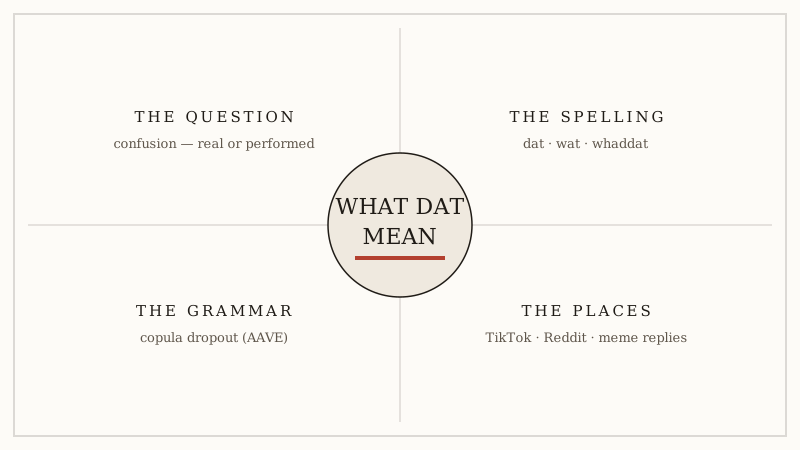
“What dat mean” is a casually spelled “what does that mean?” — same question, different accent. It asks for an explanation, exactly like the standard-English version, but the spelling does extra work: it signals that the moment is informal, funny or absurd. The what dat mean meaning in one line: confusion, worn as a joke.
Most of the time it is not even a real question. The phrase thrives as a reaction — the text equivalent of a tilted head and a squint. Someone posts a convoluted headline, a cryptic lyric, a rulebook paragraph nobody can parse, and the reply is “what dat mean 🤨.” Everyone understands it perfectly; the joke is performing the confusion to point at how confusing the thing is. And because it names the act of not-understanding, it is also this site’s favorite sentence — we built a whole dictionary around the question (ours just spells it “what that mean”).
Where the phrase comes from
The meme has a paper trail. The spelling rode a 2000s radio bit — Covino and Rich on MAXIM Radio ran a recurring character who asked “What dat mean?” at confusing moments — and from there it settled into Urban Dictionary entries and reaction-meme rotation, where it has lived ever since.
The sentence underneath is much older than the bit. Dropping the helping verb — “what that mean” instead of “what does that mean” — is a documented feature of African American Vernacular English, and swapping th- for d- (“dat,” “dis,” “dey”) shows up in AAVE, Caribbean English and Jamaican patois (“whaddat”). The radio bit didn’t invent the grammar; it borrowed a sentence people were already saying and made it a punchline. That history is worth knowing before you use the phrase (see Is “what dat mean” rude? below) — the spelling carries a real accent with it.
“What dat mean” vs “what that mean” vs “what does that mean”
Three spellings, one question, three registers — and yes, our site name is the middle one:
- “What does that mean?” — standard written English. Homework, work email, meeting a partner’s parents.
- “What that mean” — the informal spoken version; the helping verb vanishes because speech is lazy in every dialect. This is the register we named the site after: it is how the question sounds when it is actually asked out loud.
- “What dat mean” — the full meme spelling: the dropped verb plus the d-spelling. Reads as a joke even on a blank screen.
The gap between the second and third is tone, not grammar — both drop “does.” “What that mean” is a question; “what dat mean” is a bit. Choosing between them is choosing whether you want an answer or a laugh.
How people actually use it
The phrase does three distinct jobs online:
- Genuine confusion. On r/ExplainTheJoke and under dense posts, it is a real question: I did not understand this, please decode it. The spelling just admits the mood.
- Mock confusion. The advanced form — pretending not to understand something that is perfectly clear, to call out how absurd, suspicious or fake it is. “The fee is a small convenience charge of $14.99.” … “what dat mean 🤨”
- Affectionate teasing. Between friends, it is a gentle “say that again in English” — aimed at a mutual friend’s cryptic text, a nonsense exam question, a plot hole.
Platform-wise it is everywhere the reaction-image format lives: TikTok captions, X replies, Instagram comment sections, Discord. The 🤨 emoji is its most common co-star.
Examples in the wild
“Taxes filed, refund accepted, now ‘under review.’ what dat mean 😭”
“He said ‘it’s not you, it’s the timing’ then got engaged in April. what DAT mean”
“New update notes: ‘stability improvements and bug fixes.’ what dat mean — what did you FIX”
Notice the grammar pattern: the phrase sits after the evidence, like a verdict stamp — the same job smh does for judgment, this does for confusion. And the all-caps “DAT” in the middle example is the phrase’s built-in volume knob: caps turn the squint into a stare.
Is “what dat mean” rude?
It depends which way the joke points. Aimed at a situation — a confusing headline, a cryptic bill, a vague text — it is a punching-up joke at nonsense’s expense, and nobody gets hurt. Aimed at a person’s speech — imitating a non-native speaker’s accent, or using AAVE spellings as a punchline at Black speakers’ expense — it punches down, and it reads exactly as mean as it is.
The practical test: quote the phrase, don’t perform the accent. “What dat mean” at a $14.99 convenience fee is a joke; “what dat mean” in a voice making fun of how someone talks is an insult wearing a joke’s clothes. The spelling comes from real speech patterns, and the people who say it that way for real are not in on the mockery.
Questions people also ask
- What does “what dat mean” mean?
- “What dat mean” is a deliberately informal spelling of “what does that mean?” People use it to react to something confusing — or to pretend to be confused by something they understood perfectly well, which is where the meme lives. The tone is playful unless the target is a person’s accent, which flips it from joke to jab.
- Where did “what dat mean” come from?
- The meme form is usually traced to a 2000s radio bit by Covino and Rich on MAXIM Radio, in which a recurring character asked “What dat mean?” — later cemented by Urban Dictionary entries and reaction memes. The phrasing itself is much older: dropping “does” and spelling “that” as “dat” are documented features of AAVE and of several dialects, which is why the sentence felt familiar long before the meme.
- Is “what dat mean” AAVE?
- The grammar pattern is. Leaving out the helping verb — “what that mean” instead of “what does that mean” — is a well-documented feature of African American Vernacular English, and the d-spelling (“dat”) matches how th-sounds often surface in AAVE and Caribbean English. The specific meme spelling then traveled through radio and meme pages. Respecting the source matters: quoting the phrase as a joke is different from imitating the speech of the people who actually talk that way.
- What does “dat” mean in texting?
- “Dat” is a phonetic spelling of “that.” It shows up wherever casual internet writing mimics speech: AAVE-influenced spellings, Jamaican patois (“whaddat”), Caribbean and London English, and general thumbspeed typing. The family includes dis (“this”), dey (“they”), da (“the”) and wat (“what”). None of them change the word’s meaning — only its accent.
- Is “what dat mean” rude?
- As a meme reaction — genuine confusion at a joke, mock confusion at a suspicious headline — no. It turns rude when the spelling is used to mock how someone actually speaks: imitating a non-native speaker’s accent, or using AAVE spellings as a punchline at Black speakers’ expense. The test is direction: punching at a confusing situation is a joke; punching at a person’s speech is not.
More slang, decoded
- larps
The internet's word for playing a role instead of being real — pretending, not living.
- chud
The internet's monster-movie insult for an unkempt, reactionary poster.
- mogging
Outshining someone on sight — gym slang for dominating the looks comparison.
- egma
A tightened-up enigma — someone mysterious, hard to read, a little intriguing.
New here? Start with the slang guide — what internet slang is and where these words come from.