SMH Meaning
acronyms · casual, can read as dismissive · updated 2026-11-04
Shaking my head — the texter's shorthand for mild disappointment or disapproval.
What does SMH mean?
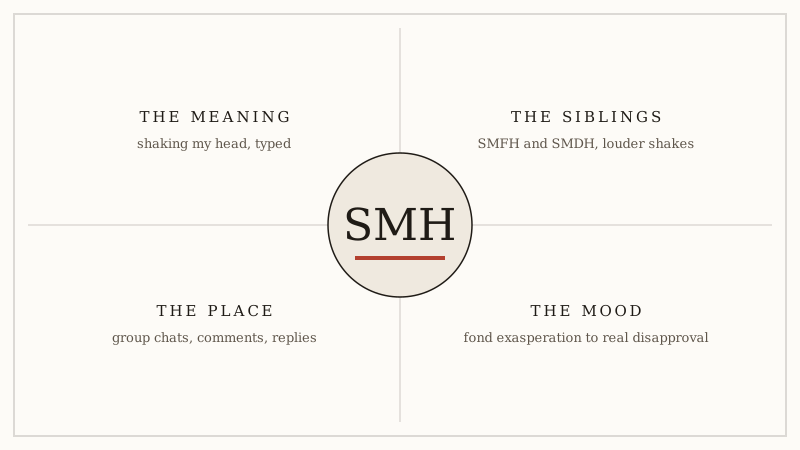
SMH stands for "shaking my head." It is the texter's shorthand for disappointment or disapproval — you send it when someone does something silly, annoying or frustrating and a written reaction would take too long. The SMH meaning in one line: a head shake you can type. It is deliberately mild: not anger, not outrage, just that quiet "come on" feeling.
What makes SMH unusual among acronyms is that it does not carry information — it carries attitude. "RSVP" tells you to do something; "TLDR" tells you what's coming; "FOMO" names a feeling. SMH does none of that. It is a gesture converted to text, three letters standing in for a physical act your face already knows how to do. That is why it attaches to almost anything: the head shake is one of the most portable expressions humans own.
Read it as a dial, not a switch. At the low end, "left my airpods at home smh" is self-deprecating humor — a head shake at yourself, fondly. At the high end, "you lied to them for months... smh" is genuine contempt with the volume turned down. Same letters, same gesture, very different rooms.
Where SMH comes from
SMH is old enough to predate emojis. It spread through early-2000s chat rooms, forums and SMS — Urban Dictionary's first entries for it date to 2004 — as a compact way to react without typing a sentence. In an era before the 🤦 emoji existed, SMH did that job in three letters, and unlike emoji it works in plain text anywhere: group chats, Reddit, YouTube comments, Discord, a reply to your uncle's post.
Its staying power comes from tone. A head shake is readable across languages and generations, and SMH kept that neutrality — which is also its risk, because a head shake can mean anything from affectionate exasperation ("you forgot your keys again, smh") to genuine disapproval ("he lied to them for months... smh").
The emoji did not kill it, either. 🤦 shows the gesture; SMH adds the judgment. "🤦 he did it again" is you watching the foolery; "he did it again smh" is you filing a report on it. That small difference — judgment versus spectacle — is why the abbreviation survived its emoji rival and still shows up in posts by people who were not alive when the acronym was coined.
What SMH means in text, on Snapchat and on TikTok
Across platforms, the letters never change meaning — only the room changes:
- In texts and DMs, SMH is a one-word reaction, usually to a friend's minor crime. "You ate my leftovers smh" is a head shake with a grin behind it.
- On Snapchat, it lives inside streak-conversation banter the same way — lightweight, teasing, self-deprecating ("bombed the quiz smh").
- On TikTok, it appears in captions and comments reacting to other people's behavior: "the way he asked for a discount on a date... smh." Here it often does the work of a full judgment paragraph.
- On Reddit and X, it tags public disappointment — the "we as a society" register — usually aimed at strangers rather than friends.
The one constant: SMH is aimed at behavior, not at facts. You SMH at what someone did — wore, said, posted, ate — not at what simply is. That behavioral targeting is why it so often arrives with a story attached.
SMFH and SMDH: the stronger siblings
SMH has two known intensifications, and both are worth recognizing even if you never send them:
- SMFH — shaking my freaking head (often standing in for a cruder f-word). The head shake plus an audible sigh. Use it when the disappointment is real enough to almost break register.
- SMDH — shaking my damn head. Sits between the two: stronger than SMH, cleaner than SMFH. Slightly dated now, heavier on forums than in DMs.
The escalation ladder matters for reading tone. If someone escalates from SMH to SMFH mid-conversation, the temperature rose — that is a signal worth noticing. And if you are choosing which to send, the house rule is simple: pick the one that matches what you would actually say out loud in that chat.
When to use it (and when not to)
SMH fits casual, fast-moving text:
- group chats and DMs, as a one-word reaction to a friend's latest bad decision
- comments and replies, reacting to a public facepalm moment
- self-deprecating posts — "left my wallet at home smh" — where it reads as humor
Leave it out of anything professional or serious. "SMH" in a work email reads as condescending; in reply to someone's sincere mistake it reads as cold. And if you are actually upset, say so — SMH communicates disappointment while refusing to explain it, which is exactly what makes it feel passive-aggressive when the stakes are real.
Examples in the wild
"The meeting that could have been an email... smh"
"She said 'no offense' and then said the most offensive thing possible. smh"
"Left my airpods in the library. Again. smh at myself"
"Team's up by 20 and he's still shooting threes smh"
"Bro returned the rental car with a full detail job done. I said full. smh"
Notice what each of these does: the SMH arrives after the evidence, like a verdict stamp. Nobody explains why they're shaking their head — the story carries the judgment, and SMH just signs it. That's the cleanest way to understand the acronym's job in a sentence: it is a signature on a complaint, not the complaint itself.
Is SMH rude?
It depends on which end of the dial you mean. As a reaction to strangers' public foolery, SMH is standard-issue internet and nobody blinks. As a reply to a friend's joke confession, it is affectionate — the head shake that says "you're ridiculous and I love you." In neither case is it rude.
It starts to read as rude when it is pointed at a real person about a real stake: the coworker who answers a sincere question with "smh," the partner who responds to an apology with "smh" instead of words. There, the acronym's core flaw activates — it shows judgment and withholds the reason. The receiver gets the head shake without the conversation. If you catch yourself sending SMH during an argument, translate the feeling into a sentence instead; the head shake will not do the talking for you.
How people get SMH wrong
Three recurring mistakes. First, reading it as furious — SMH is the mild end of disapproval; if someone sends you SMH, they are rolling their eyes, not shouting. Second, assuming capitalization changes the meaning — capitals add intensity but it is still the same head shake; lowercase is simply the standard register. Third, mixing it up with its neighbors: SMFH is the stronger sibling, while SMDH (shaking my damn head) sits between them. When in doubt, plain SMH is the safest register.
A fourth, newer one is worth naming: using SMH where 🤦 belongs. The emoji shows you watching the spectacle; the letters show you judging it. Sending SMH at a friend's harmless self-own can read colder than you intended — sometimes the head shake should stay a facepalm.
How SMH relates to TLDR, FOMO and RSVP
SMH belongs to a small family of acronyms that carry whole social gestures in a few letters:
- TLDR is the sibling with a job — it summarizes or dismisses. Where SMH judges behavior, TLDR handles text length.
- FOMO names a feeling instead of a gesture — the ache of missing out. The two often travel together: "everyone went without me... smh, the fomo is real."
- RSVP is the formal elder of the family — French etiquette, not SMS shorthand. It asks for an answer; SMH is the answer, just not a kind one: declining your invite with "can't, smh" at least explains the sigh.
- DEI is the family's suit-and-tie cousin — diversity, equity and inclusion, an acronym that left the group chat for the boardroom. Where SMH compresses a gesture, DEI compresses a whole policy framework.
Together they show how compressed texting became: a judgment (smh), a summary (tldr), a feeling (fomo) and a demand (rsvp) — four whole messages, eleven letters.
Related acronyms
- TLDR
Too long; didn't read — the internet's one-line summary, or its polite shove.
- FOMO
Fear of missing out — the ache of watching a moment happen without you.
- RSVP
Répondez s'il vous plaît — respond, if you please: the invitation's headcount request.
- DEI
Diversity, equity and inclusion — the workplace framework acronym that became a political flashpoint.
Questions people also ask
- What does SMH mean in texting?
- SMH means shaking my head. It is a reaction to something disappointing, silly or frustrating — the digital equivalent of a slow head shake. It never stands for something rude, despite what chain emails claimed in the 2010s.
- Is SMH rude?
- SMH is mild, but it is not warm. Because it signals disapproval without saying why, it can read as dismissive or passive-aggressive — especially from a boss or in reply to a sincere question. With friends it is fine; in a serious conversation, say what you actually mean.
- What is the difference between SMH and SMFH?
- SMFH is the stronger version — shaking my freaking head (or a cruder f-word). SMH is a head shake; SMFH is a head shake with an audible sigh. If you would not swear out loud in that chat, stay with SMH.
- What does SMH mean from a girl — or from anyone?
- The same thing regardless of who sends it: disappointment or exasperation. Tone comes from the relationship and the message around it — 'smh' after a joke is affectionate teasing, 'smh' after a broken promise is real disapproval. The letters do not change; the context does.
- Should SMH be capitalized?
- Both forms work. Lowercase 'smh' reads as casual and a little weary — the standard register in texting. All-caps 'SMH' adds emphasis, like shaking the head harder. Neither changes the meaning; caps only change the volume.
New here? Start with the acronyms guide — what acronyms are and where the readings come from.