DEI Meaning
acronyms · formal; politically charged · updated 2026-11-04
Diversity, equity and inclusion — the workplace framework acronym that became a political flashpoint.
What does DEI mean?
DEI stands for diversity, equity and inclusion. It is the umbrella acronym for the policies organizations use to build workforces made up of different kinds of people (diversity), to make their processes fair (equity), and to make sure those people can actually take part once hired (inclusion). You will meet it in job postings, corporate reports, university pages and news headlines — usually with no explanation, because by now the three letters are expected to carry the whole paragraph. The DEI meaning in one line: a three-word framework for who gets in, whether the rules are fair, and who gets heard.
DEI is the suit-and-tie member of the acronym family. SMH, TLDR and FOMO were born in chats and comment sections; DEI was born in HR departments and policy papers. Same compression instinct — three letters instead of a sentence — but a completely different register. That gap between registers is exactly why the acronym has become slippery: on a careers page it is a department name, and in a comment section it is usually a fighting word. A definition that only covers one of those two lives is half a definition.
One more thing worth saying up front, dictionary-style: nothing about the acronym tells you whether a specific program was good or bad at a specific company. DEI names a policy category, the way "marketing" does. The arguments are about particular programs and politics — the letters themselves just carry the framework.
Where DEI comes from
The ideas are much older than the initials. Workplace diversity as a management discipline dates to the late 1980s — R. Roosevelt Thomas Jr.'s 1990 Harvard Business Review essay "From Affirmative Action to Affirming Diversity" is the standard milestone — when American companies began treating a diverse workforce as a competitive asset rather than a compliance burden. The 1990s added diversity training and the first chief diversity officers; the 2000s made both mainstream; and somewhere in the 2010s the three words settled into today's fixed order and started traveling as one unit: DEI.
Then the 2020s turned the volume up on both sides. Interest spiked in 2020, when companies made public commitments and hired at scale. From 2023 the pendulum swung back: U.S. executive actions rolled back federal diversity initiatives, some corporations cut or quietly renamed their programs, and several states passed laws restricting DEI at public universities. The acronym itself became politically marked — which is why, today, a dictionary definition has to cover both the policy framework and the argument about it.
The honest timeline, then: an HR term of art (late 1980s), a corporate boom (2020–2022), a backlash-and-rebrand era (2023 onward). None of that moved the letters. DEI has meant diversity, equity and inclusion the whole time.
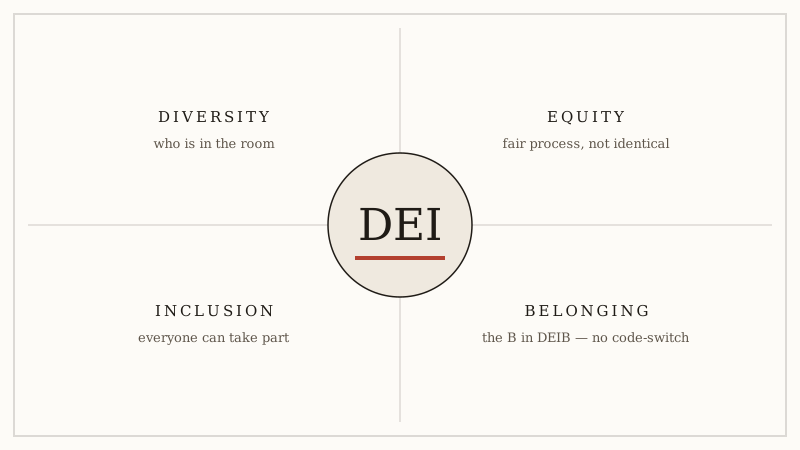
The three pillars: diversity, equity, inclusion
The acronym compresses three different jobs, and the distinctions are where most of the confusion lives:
- Diversity — who is in the room. Representation across race, gender, age, disability, veteran status, religion, class and background. This is the measurable layer: the numbers an organization can count and report.
- Equity — whether the process is fair. Not the same as equality, and the swap is the single most common mistake in this territory. Equality gives everyone identical treatment; equity adjusts for the fact that people arrive with unequal starting points. The famous illustration (widely credited to Craig Froehle's 2012 sketch of two kids watching a baseball game over a fence) is the standard shortcut: equality hands everyone the same box; equity hands boxes until everyone can see over the fence.
- Inclusion — whether the people in the room can actually participate. Voice, safety, being taken seriously. A diverse room where only one kind of person talks is diverse on paper and homogenous in practice.
The line advocates quote to keep the pillars straight comes from inclusion strategist Vernā Myers: diversity is being invited to the party, inclusion is being asked to dance. Equity, extended into the same frame, is making sure everyone could get to the party at all. A fourth word — belonging, the B in DEIB — names the end state: you are at the party, dancing, and nobody needs you to be someone else while you do it.
What is a "DEI hire"?
This is the phrase most people are actually looking up, so it deserves its own straight answer. A "DEI hire" is a label — almost always critical — implying that someone got their job because of identity rather than qualifications.
Two things are true at once. First, DEI-informed hiring is real: the standard practices are widening recruitment pipelines, structuring interviews so candidates answer the same questions in the same order, and auditing criteria that screen people out for irrelevant reasons. None of that is quota hiring, and "diversity was considered in the process" is a different claim from "hired instead of better candidates."
Second, the label as used online is usually an insult fired without evidence — very often at people with conventional, strong qualifications. Calling a specific person a "DEI hire" claims to know why they were hired; outside the hiring room, nobody does. In practice the label says more about the speaker's politics than the target's résumé. That is a tone note, not a political one: the same entry that explains the acronym can also tell you how the insult works.
Variants: DEIB, JEDI, D&I, EDI
The initials drift, and knowing the variants saves you a double-take when an older document or a different country's university uses different letters:
- DEIB — diversity, equity, inclusion and belonging. The most common modern expansion, adding the end-state as a fourth pillar.
- JEDI — justice, equity, diversity, inclusion. Yes, the Star Wars spelling is intentional; you will mostly meet it in academic and nonprofit settings.
- D&I — the older order, common in pre-2015 documents. Plenty of organizations never upgraded.
- EDI — equity first; the order preferred in UK and EU institutions, especially universities.
The drift is political as much as stylistic: rebrandings tend to follow shifts in emphasis — or in what is currently safe to fund. When a company renames its DEI office "talent and culture," the initials changed; the argument did not.
Is DEI a rude word?
The letters are not; the usage can be. In a workplace, DEI is neutral furniture — a department, a training session, a line in an annual report. In comment sections and political argument, "DEI" is frequently shorthand used either approvingly ("we stand for DEI") or dismissively ("that's DEI nonsense"), and applied to a person ("a DEI hire") it is an insult in practically every context.
The practical register guide: use DEI to describe programs and policies, not people. Describing a person with it is either an HR category error or a jab — and readers will assume the jab.
Examples in the wild
"Our DEI report is out — first year we've disclosed pay-gap data."
"They dissolved the entire DEI team in the spring restructuring."
"'She's a DEI hire.' Brother, she has a PhD and a decade in the field. Come on."
"The job posting says a DEI statement is optional. What that mean for my odds?"
Notice the grammar: DEI works as an adjective more than a noun — DEI training, DEI office, DEI hire. When it appears as a bare noun ("DEI is under review"), it names the whole policy area, not a single thing you can point to.
How people get DEI wrong
Four recurring mistakes. First, swapping equity and equality — they are different claims, and the whole framework depends on the difference. Second, treating DEI as a single organization with a leader and a membership ("who runs DEI?") — it is a policy category, not a club. Third, assuming it is only about race — the standard scope includes gender, disability, age, veterans, religion and more. Fourth, using "DEI hire" as if it were a neutral description — it is not; it is a loaded claim, and almost always an evidence-free one.
How DEI relates to SMH, TLDR, FOMO and RSVP
DEI belongs to the same acronym family as the texting shorthand on this site — same compression instinct, different birthplace:
- SMH compresses a gesture — judgment in three letters, born in chat rooms.
- TLDR compresses an act — skip the reading, take the summary.
- FOMO compresses a feeling — the ache of the party you missed.
- RSVP compresses a demand — respond, if you please; the family's etiquette elder, born in French rather than in SMS.
DEI compresses a policy framework — a paragraph of organizational intent in three letters. It is the boardroom's answer to the group chat's shorthand: from smh to dei, the family proves the same trick works at every register — three letters can carry a head shake or a compliance department, depending on which room they were born in.
Related acronyms
- SMH
Shaking my head — the texter's shorthand for mild disappointment or disapproval.
- TLDR
Too long; didn't read — the internet's one-line summary, or its polite shove.
- FOMO
Fear of missing out — the ache of watching a moment happen without you.
- RSVP
Répondez s'il vous plaît — respond, if you please: the invitation's headcount request.
Questions people also ask
- What does DEI stand for?
- DEI stands for diversity, equity and inclusion. Diversity is about who is in the room, equity is about whether the process is fair to them, and inclusion is about whether they can actually speak and belong once there. Organizations use the acronym as shorthand for policies covering hiring, promotion, training and culture.
- What are the three pillars of DEI?
- Diversity (representation across race, gender, age, disability, background and more), equity (fair access and process — which is not the same as treating everyone identically) and inclusion (whether people can take part and belong once they are in). A fourth pillar, belonging, is sometimes added — that is the B in DEIB.
- What is a DEI hire?
- ‘DEI hire’ is a label, almost always critical, implying someone was hired for identity rather than qualifications — a claim usually made without evidence about the person's actual record. In DEI-informed hiring itself, the typical practice is widening recruitment pools and structuring interviews, not quota hiring. Since 2024 the label has become a common insult in political arguments.
- What do DEIB and JEDI stand for?
- DEIB adds belonging — diversity, equity, inclusion and belonging. JEDI adds justice — justice, equity, diversity and inclusion (and yes, the Star Wars spelling is intentional). Older documents may say D&I, or EDI, the order common at UK and EU universities. Same family, shifting initials.
- What does DEI mean in slang?
- In casual use, DEI has picked up a second life as a dismissive label — calling someone or something ‘DEI’ to imply undeserved placement. Used that way it is a jab, and often an insult to a qualified person. In workplace settings the letters are neutral policy jargon; the tone comes entirely from who is saying them and why.
- Is DEI still required in the US?
- No federal law requires companies to run DEI programs — in the private sector they have always been mostly voluntary. The 2020s changed the direction of travel: federal diversity initiatives were rolled back, some companies scaled programs back or renamed them, and several states restricted DEI at public institutions. Rules now vary by state and sector, so check the current ones for yours.
New here? Start with the acronyms guide — what acronyms are and where the readings come from.