RSVP Meaning
acronyms · formal etiquette · updated 2026-11-04
Répondez s'il vous plaît — respond, if you please: the invitation's headcount request.
What does RSVP stand for?
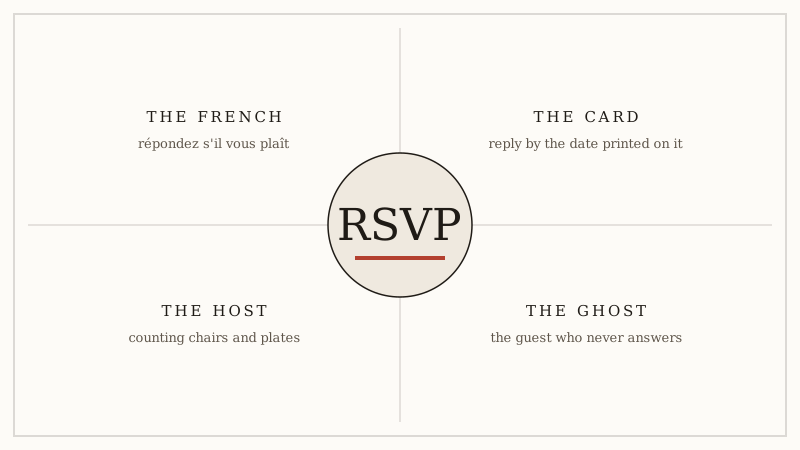
RSVP stands for "répondez s'il vous plaît" — French for "respond, if you please." On an invitation it is a request: tell the host whether you are coming, by the date given. The RSVP meaning in one line: the host is asking for a headcount, politely.
It is the odd one out in this dictionary. SMH, TLDR and FOMO were born of keyboards; RSVP is older than every abbreviation in this family by centuries — an import from French etiquette that English-speaking society adopted wholesale. It asks for a behavior rather than naming a feeling, and it comes with a deadline. That combination — request, deadline, cost riding on the answer — is why RSVP feels formal even printed on a child's pool-party card.
One detail that surprises people: the French don't actually use "RSVP." French invitations are more likely to spell out "réponse souhaitée" (reply requested) or similar. The four-letter abbreviation is largely an English-speaking convention — we borrowed the phrase, compressed it, and made it more permanent than it ever was in Paris.
Where RSVP came from
The phrase comes from the era when invitations were handwritten and social life ran on etiquette: a host needed to know how many places to set, and the polite fiction was that the guest's reply was a courtesy — s'il vous plaît, "if you please" — rather than a logistical necessity. Aristocratic French gave the phrase to European high society; English-speaking high society borrowed it whole, abbreviation and all.
The abbreviation stuck because it solved a printing problem: invitations needed the request in minimal space, and four letters fit on a card where a full sentence cluttered. From formal weddings it spread outward and downward through society — restaurant listings ("RSVP required"), charity galas, office parties, and eventually the kids' birthday invite with a WhatsApp number at the bottom. Same four letters, same request, three centuries of degradation in formality.
The logistics underneath never changed, though, and that is the key to the whole convention: the host is paying per head. Every chair, plate, favor and sandwich is a unit cost multiplied by an unknown. The RSVP exists because guessing is expensive in both directions — too much food, or a friend standing at a table that isn't there.
What RSVP means on an invitation
When you see RSVP on an invitation, it packs three instructions into one request:
- Reply — answer the host with your yes or no, for exactly the people named on the invitation. Not "the Smiths plus the cousins"; the Smiths.
- By the date — the "RSVP by" date is a real deadline, chosen so the host can finalize catering and seating. Replying after it is better than never, but the date is doing work; treat it as real.
- In the way asked — if there's a reply card, mail the card; if there's a form, fill the form; if it says "text Maria," text Maria. Modern invitations increasingly use QR codes and links, and hosts genuinely prefer the channel they chose — it keeps the headcount in one place.
Two variations you'll see and should read correctly: "RSVP by [date]" (standard — answer by then) and "regrets only" (the flip — reply only if you are not coming; silence means yes and your chair is saved). "Regrets only" is the one convention where silence is the correct answer, which makes it the exception that proves the whole rule: everywhere else, the RSVP is asking for sound.
How to RSVP (and how to nudge one)
For guests, the rules are short:
- answer in the form the invitation asked for, by the date, for the people named
- answer clearly — "we'd love to come" is a compliment, not an RSVP; "the Smiths, happily attending" is an RSVP
- if plans collapse after a yes, tell the host immediately; a late no with an apology beats a no-show with one
For hosts, the toolkit is equally short:
- set the RSVP date two to three weeks before the event, with a cushion to chase stragglers
- make replying one tap: a form link or QR code beats "find the card you lost in January"
- nudge gently and specifically — "hi! We're finalizing numbers Friday, still good for two?" is polite and produces an answer; "just checking in" produces nothing
The template sentence for chasing silent guests, worth keeping: "So excited for the party — could you confirm by Friday whether you two can make it? Catering counts on Monday." It names the deadline, the reason, and the exact question. Nobody ghosts a question that clear twice.
Examples in the wild
"RSVP by June 3 — the venue needs final numbers the next morning."
"Please RSVP on the site, not the group chat. The group chat is where RSVPs go to die."
"'Regrets only' on the invite meant silence was a yes — forty chairs, zero regrets, one very smug host."
"I ghosted the RSVP and ended up watching the wedding on the livestream. Lesson learned: one text would have fixed it."
Hmm — the examples are where invitation culture and text culture collide: RSVP has even become a verb in casual speech ("rsvp to my poll," "rsvp in the comments"), usually lowercase and half-joking, meaning simply respond. The formal request became a casual verb, which is a word doing exactly what a living language wants.
Is it rude not to RSVP?
In etiquette terms, yes — clearly. The RSVP is a request with a reason attached: the host is paying per head and planning per person, and silence is not neutrality, it is an unknown quantity sitting on the budget. A missing RSVP costs the host real decisions: do they pay for your plate in case you show? Do they seat a table around a maybe? Ghosting the request answers none of it while consuming their attention — which is why "rude" is the correct classification and not just old-fashioned fuss.
The realistic version is kinder to everyone: people forget, invitations arrive in chaotic inboxes, and most no-RSVPs are oversights, not insults. The repair is one sentence — "I'm so sorry, I just realized I never replied to your invite: we'd love to come / we can't make it." Hosts forgive the oversight and remember the apology. What they don't forgive is the pattern — the guest who never RSVPs to anything, ever, and is consequently planned around like weather.
How people get RSVP wrong
First, the plus-one fantasy: RSVPing for people who weren't invited. The invitation names its guests; "the Smiths" does not expand to include the Smiths' houseguest, and asking "can I bring the kids?" is a question for the host, not an assumption for the reply card.
Second, misreading "regrets only" as decorative French. It is a functional instruction — silence means yes, and no-showing a regrets-only event leaves a paid-for chair empty. If you don't understand the convention, that's fine; ask rather than assume.
Third, the eternal maybe: replying "I'll try to make it!" to a request for a headcount. Hosts cannot cater ambition. A soft maybe is a no with better PR — say which one you mean.
How RSVP relates to SMH, TLDR and FOMO
RSVP sits in the acronym family, but it's the family's elder statesman:
- SMH is what the no-RSVP guest eventually earns — a judgment you can type. The head shake after "still haven't replied to my invite" is the family at work.
- TLDR compresses text; RSVP compresses etiquette — four letters carrying an entire social contract. Both prove the same point: compression works when the meaning is already famous.
- FOMO is the unanswered RSVP's emotional aftermath — the ache of watching the party you never replied to. The invitation asks; the ghost pays.
- DEI is RSVP's workplace counterpart — also formal, also procedural, also compressed. One asks for an answer by a date; the other names an entire policy area in three letters.
One request, one judgment, one summary, one ache: rsvp demands, smh judges, tldr summarizes, fomo aches. The family covers the whole arc of a group chat — from invitation to headcount to recap to regret.
Related acronyms
- SMH
Shaking my head — the texter's shorthand for mild disappointment or disapproval.
- TLDR
Too long; didn't read — the internet's one-line summary, or its polite shove.
- FOMO
Fear of missing out — the ache of watching a moment happen without you.
- DEI
Diversity, equity and inclusion — the workplace framework acronym that became a political flashpoint.
Questions people also ask
- What does RSVP stand for?
- RSVP stands for the French phrase 'répondez s'il vous plaît' — 'respond, if you please.' On an invitation it is a request to tell the host whether you are coming, by the date given, so they can plan seats, food and budget.
- Do you have to RSVP if you can't go?
- Yes — the host needs your no as much as your yes. An RSVP is a request for an answer, not an acceptance form. Silence leaves the host counting you ambiguously; a polite 'so sorry, can't make it' closes the loop.
- What does RSVP mean on a birthday invitation?
- The same thing it means anywhere: reply with your answer by the date printed. On kids' party invitations it also settles the guest-list question — an RSVP is for the people actually named on the invite, not their siblings plus whoever else is free.
- What does 'regrets only' mean?
- 'Regrets only' flips the RSVP: you reply only if you are declining. Silence means yes and a chair is saved for you. It is the one invitation convention where not responding is the correct response — every other RSVP expects an answer.
- Is it rude not to RSVP?
- In etiquette terms, yes. The RSVP exists because the host is paying per head — catering counts, seat counts, budgets count — and ghosting the request leaves them planning around an unknown. If you already skipped one, apologize and answer late; late beats never.
New here? Start with the acronyms guide — what acronyms are and where the readings come from.