FOMO Meaning
acronyms · casual, universal · updated 2026-11-04
Fear of missing out — the ache of watching a moment happen without you.
What does FOMO mean?
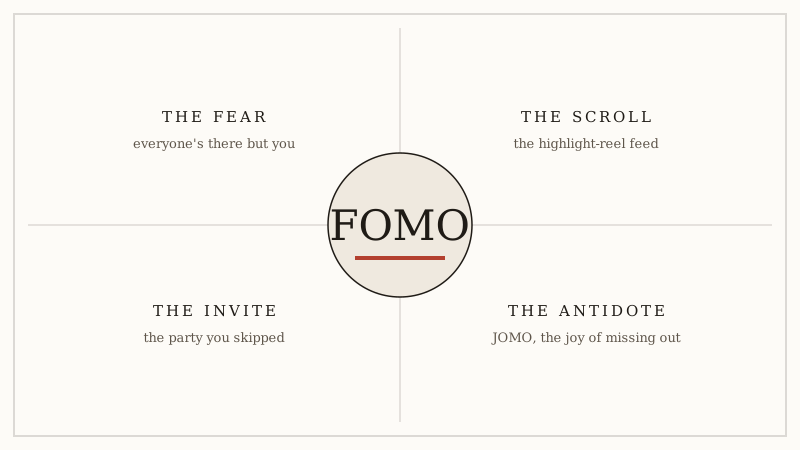
FOMO stands for "fear of missing out." It is the anxious feeling that something interesting or socially important is happening without you — the party you skipped, the group chat you muted, the trip everyone posted except you attended. The FOMO meaning in one line: the ache of watching a moment happen in other people's photos.
Unlike most slang in this dictionary, FOMO names a feeling rather than a gesture or a person. SMH judges behavior; TLDR compresses text; FOMO sits inside you. That interior quality is why the word spread so far — everyone has the feeling, and having a name for it turned a private ache into a shareable, jokeable, universally recognized condition. You can say "I have fomo" to a stranger and be understood completely.
It is also the rare slang word that psychology took seriously. Researchers have studied FOMO formally — linking it to social comparison, phone-checking habits and lower well-being — which means the word sits in an unusual position: casual enough for a text message, documented enough for a journal paper. The acronym is informal; the experience is real.
Where FOMO comes from
The term is usually credited to Patrick McGinnis, who used "FOMO" in a 2004 piece in The Harbus, the Harvard Business School's student magazine — describing the anxiety of MBA students who treated every gathering as an option they might be losing. From business-school jokes the word spread through tech and startup circles, where it became shorthand for the opportunity-cost anxiety of people who treat life like a portfolio.
Then the smartphone arrived and did to FOMO what stadiums do to echoes. Before feeds, fear of missing out required knowing what you were missing — a photo album shown at dinner, a story from a friend. After feeds, the evidence arrived continuously, curated to the best frame of everyone else's evening. The 2010s made FOMO ambient: not an occasional pang but a scrolling posture, checked in on between other things.
The timeline explains the word's tone. FOMO never had a counterculture birth like chud or a forum-native heckle phase like TLDR — it came from business-school prose, went viral on genuine universal experience, and entered dictionaries within a decade. That is why it sounds clean to every generation at once: grandma has fomo, and so does the group chat.
Why social media supercharged it
FOMO needs two ingredients: something happening, and you knowing about it. Feeds industrialized both. The something-happening is now infinite (everyone's life, every night, in high resolution), and the knowing is automatic (push notifications doing the work curiosity used to do). The result is a machine for manufacturing the exact feeling the word names — which is why "doomscrolling" and "fomo" so often describe the same evening.
The craft of feeds makes it worse in one specific way: everyone posts their highlights, so you compare your whole evening to everyone else's best frame. Nobody posts the part where they stood in the kitchen checking their phone. The comparison is rigged by design, and FOMO is the interest you pay on it.
Worth naming, too, is the newest layer: FOMO has become a marketing word. "Don't miss out," "limited spots," "last chance" — urgency copy is FOMO aimed at your wallet. The feeling was named to be shared among friends; brands read the same research and priced it.
FOMO in texts and posts: how people actually use it
The usage grammar is flexible, which helped the spread:
- as a noun — "the fomo is real," "my fomo got me" (you went somewhere because skipping felt worse)
- as a confession — "didn't make it to the thing and the fomo is killing me" (the group chat knows)
- as a vibe — "fomo hours" at 11 p.m. watching stories you'd rather not see
- as an excuse — "I only signed up because of fomo," which everyone recognizes and no one judges
Register note: FOMO works in almost any casual context, which is unusual for this dictionary's entries. SMH in a work email is a problem; "moving the deadline, don't want anyone to have fomo" in a work Slack is completely normal. The word kept its business-school polish while going fully casual — rare trajectory, and part of why it stuck.
FOMO vs JOMO
The backlash word arrived on schedule: JOMO — the joy of missing out. It is the deliberate pleasure of skipping: staying in, logging off, missing the thing on purpose and enjoying the quiet. Where FOMO scrolls at 11 p.m. wishing it were elsewhere, JOMO turns the phone face down and calls that the plan.
JOMO is younger and smaller than FOMO — the feeling is real but the word never crossed into universal use the way FOMO did. Still, it works as the antidote framing, and the pair is now standard vocabulary in digital-wellbeing advice: name the fear (FOMO), practice the opposite (JOMO). If FOMO is the interest payment on everyone else's highlight reel, JOMO is the debt-relief plan: skip more things, miss fewer lives.
When to use it (and when not to)
FOMO fits almost any casual register:
- texts and group chats, confessing the ache — "the fomo is unreal rn"
- social posts, captioning the skipped party or the muted group trip
- work-adjacent Slack, half-joking — "signing up purely out of fomo"
Go careful in two places. First, real mental-health conversations: FOMO is a fine word for a passing ache, but if someone is describing genuine distress — isolation, compulsive checking, depression — naming it with a meme word can flatten it; meet the feeling at its actual size. Second, don't weaponize it: "you'll have fomo if you skip" aimed at someone who already declined is salesmanship, and everyone can smell it.
Examples in the wild
"Everyone's posting from the cabin and I'm in the library. The fomo is eating me alive."
"I only went to the networking thing because of fomo. Talked to two people, left in 40 minutes."
"Missed the group trip and my fomo lasted exactly one scroll. Then I remembered the beds there."
"No fomo whatsoever tonight. Phone is dead, pizza is here, JOMO unlocked."
Notice the emotional range the word handles: genuine ache, self-aware confession, recovered composure, and total peace — four life stages of the same skipped party, all named with one acronym. That flexibility is why FOMO outlived the platform trends that fed it: the feeling predates the feed and will outlast it.
Is FOMO a real thing?
The word is casual; the research is real. Psychologists have studied fear of missing out formally for over a decade — measuring it, linking it to social comparison orientation, phone-checking frequency, lower mood and life satisfaction. The finding across studies is consistent: FOMO is a genuine, measurable pattern, not just a caption. People who score higher on it check phones more, enjoy present moments less, and report more social comparison — the feeling has a footprint.
What it is not, in any of this research, is a disorder. It is a common anxiety pattern — universal enough that a 2004 business-school joke named it, mediated enough that the 2010s amplified it, human enough that it will outlive every app that feeds it. The honest summary: FOMO is a real feeling with a silly-sounding name and a serious bibliography. Take the feeling seriously; feel free to keep the name light.
How people get FOMO wrong
First, shrinking it to parties. FOMO ranks careers (everyone's funding round), families (everyone's holiday card), hobbies (everyone's marathon), even rest (everyone's silent retreat). The feeling tracks comparison, not calendars — any dimension with visible winners can carry it.
Second, confusing it with envy. Envy wants what someone else has; FOMO fears missing a moment — it is about presence, not possession. You can envy a stranger's house and never lose sleep over it; FOMO is specifically the ticking-clock version, the sense that the door is closing on an experience you're not in.
Third, assuming it is a young person's condition. The research finds FOMO across ages — anyone with a feed and a comparison habit qualifies. The platforms that amplify it are recent; the feeling of being left out of the gathering around the fire is older than writing, and the acronym only named it in 2004.
How FOMO relates to SMH, TLDR and RSVP
FOMO belongs to the small acronym family that compresses whole social moves:
- SMH pairs with FOMO constantly in the wild — "missed the trip... smh, the fomo is real" — the judgment and the ache in one breath.
- TLDR is FOMO's structural cousin: both are compressions. TLDR compresses an act (reading); FOMO compresses an emotion (missing out).
- RSVP is where FOMO starts — the unanswered invitation is the feeling's native habitat. Respond, if you please; the ache, if you don't.
- DEI is the family's boardroom branch — three letters for a whole policy area. The feelings FOMO names in private, DEI's letters negotiate in meetings.
The family photo: fomo aches, smh judges, tldr summarizes, rsvp demands. One feeling, one judgment, one summary, one demand — the entire emotional range of a group chat, eleven letters.
Related acronyms
- SMH
Shaking my head — the texter's shorthand for mild disappointment or disapproval.
- TLDR
Too long; didn't read — the internet's one-line summary, or its polite shove.
- RSVP
Répondez s'il vous plaît — respond, if you please: the invitation's headcount request.
- DEI
Diversity, equity and inclusion — the workplace framework acronym that became a political flashpoint.
Questions people also ask
- What does FOMO stand for?
- FOMO stands for 'fear of missing out' — the anxious feeling that something interesting, rewarding or socially important is happening without you, usually fed by what you see on other people's feeds.
- Who coined the term FOMO?
- The term is usually credited to Patrick McGinnis, who used 'FOMO' in a 2004 piece in The Harbus, the Harvard Business School student magazine. It spread through business and tech circles, then went mainstream with smartphones and social media.
- Is FOMO a mental health condition?
- No — FOMO is a feeling, not a diagnosis. Psychologists do study it seriously (it is linked to social comparison and lower well-being), but it is everyday anxiety about missing experiences, not a clinical condition. Persistent distress deserves real support, not a label.
- What is the opposite of FOMO?
- JOMO — the joy of missing out. It is the deliberate pleasure of skipping: staying in, logging off, missing the party on purpose. Where FOMO scrolls, JOMO closes the laptop and calls it a win.
- What does FOMO mean in text?
- In texts, FOMO names the feeling casually: 'the fomo is killing me' while friends post from a trip you skipped. It works as a noun ('my fomo is real'), a vibe ('fomo hours'), or an excuse ('I only came because of fomo').
New here? Start with the acronyms guide — what acronyms are and where the readings come from.