NPC Meaning
acronyms · edgy; dismissive of people · updated 2026-11-04
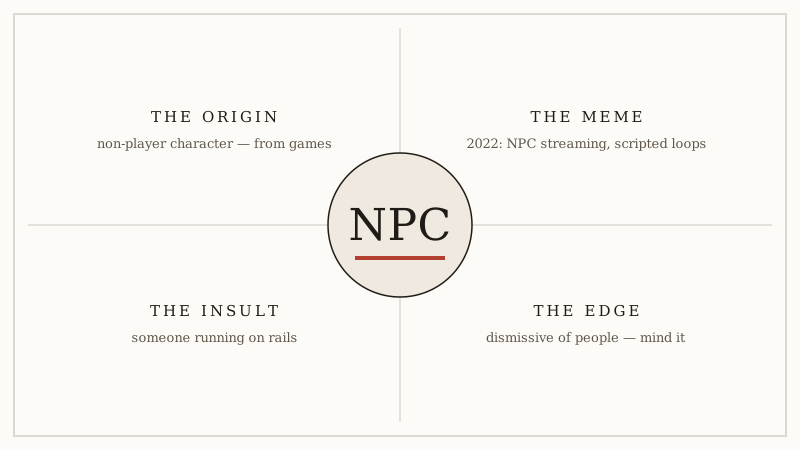
Non-player character — the insult for someone running on rails.
What does NPC mean?
NPC stands for non-player character — gaming's term for everyone in a game world who isn't you: the shopkeeper, the quest-giver, the guard who says "halt" forever. The NPC meaning in one line, current-slang division: the insult for a person running on rails — someone whose opinions, reactions and personality are presumed to be scripted, repeated, and not really theirs.
The word travels with a tidy little metaphor, which is why it spread. An NPC in a game has a dialogue tree: same inputs, same outputs, no interiority behind the responses. Calling a person an NPC claims the same architecture for them — the political takes that always match the tribe's talking points, the catchphrases deployed on schedule, the strong opinions that suspiciously never surprise you. It's a dismissive frame with the cleanliness of a technical term, and that tidiness is exactly what makes it sharper than older insults of its type ("sheep," "bot").
Because the word has a double life — neutral gaming term and loaded social insult — context does all the routing. In a game forum, NPC means the merchant; in a political thread, it means you, allegedly. Fluent readers switch registers on the venue instantly, and the definition has to hold both, because the search traffic holds both: gamers looking for quest logic and culture-warriors looking for a put-down share the three letters.
Worth knowing what NPC is not: it's not new (the term is 50 years old), it's not an acronym (you say the letters — it's an initialism, a fun fact this site's acronym guide uses as its textbook example), and it's never a compliment when aimed at a person. The closest it gets to kind is affectionate teasing between friends — which is real, and thin.
Where NPC comes from
The term is tabletop-old. In 1970s Dungeons & Dragons, the cast of a campaign split into PCs (player characters — the ones controlled by humans around the table) and NPCs (everyone else, voiced and moved by the game master). Video games inherited the vocabulary wholesale, and by the 1990s NPC was standard in every RPG: the scripted souls who populate worlds, hand out quests, and stand in one place for the entire eternity of the game.
The migration to insult ran through two distinct memes. First, 2018: the NPC Wojak. Born on 4chan's political boards, the gray, blank-faced character — sometimes with a speech bubble of soy — was used to mock the other side's followers as scripted: same phrases, no inner life. It spread fast, got weaponized in the era's political wars, and permanently installed the insult sense of the word (it remains edgy; the corners that coined it have not mellowed).
Second, 2023: NPC streaming. On TikTok Live, creators — PinkyDoll most famously — began performing as literal NPCs: repeating fixed phrases and robotic gestures in response to virtual gifts, the "ice cream so good" era. The trend was weird, lucrative (gifts pour in to trigger the loops), and culturally strange: it took the word's most dehumanizing metaphor and made it a job. Between the two memes, the word's meaning settled where it now lives — the tidy insult for the scripted person, with a profitable art-performance side quest.
What calling someone an NPC actually claims
The insult makes three claims at once, and it's worth reading them separately:
- Scripted speech. The person's opinions allegedly match a script — the tribe's, the algorithm's, the trend's — and could have been predicted in advance. (This is the claim with teeth, because everyone recognizes the experience of encountering it, including in mirrors.)
- No interiority. The stronger, crueler claim: not just that they repeat ideas, but that there's no one home behind the repetition — no doubts, no private revisions, no 3am second thoughts. This is the dehumanizing core: it denies the target an inner life.
- Non-agency. NPCs don't act; they're triggered. The insult frames the person's behavior as button-press output — stimulus, response, nothing between.
The reason the word stings is the second claim. "You're wrong" argues with a person; "you're an NPC" unpersons them — and everyone on the internet has felt both the swing and the hit. The usage guidance writes itself from the anatomy: the first claim (scripted-ness) is at least arguable and sometimes fair as social observation; the second and third are where the word stops being analysis and starts being contempt. The meme's gray face isn't smiling.
When to use it (and the hard limit)
NPC fits the gaming context always and the banter context narrowly:
- gaming talk, zero irony tax: "the NPC prices in this town are criminal"
- affectionate teasing among close friends with a running bit: "he said 'sure thing boss' to a scam email. beloved NPC"
- self-deprecation, the safe harbor: "I followed the GPS into a lake. NPC behavior from me"
The hard limit is third-person, serious, or group-directed. "NPCs voted for this" is the word doing its worst work — stripping interiority from millions of people in one noun. And the subtler limit: because the insult's engine is predictability, it's always aimed from the inside of one orthodoxy at the outside of another — the mocker's own scripts exempt, as scripts always are. The internet's most reliable NPC behavior, it turns out, is calling other people NPCs.
Examples in the wild
"he opens every argument with 'well actually' and a screenshot. certified NPC"
"the barista asked how my day was and I said 'good, you?' — the NPC script is REAL"
"watched a 40-minute NPC stream last night. she said 'ice cream so good' maybe 400 times and made more than my rent. what that mean for society"
Notice the grammar: NPC is a predicate, not an exclamation — it lands as a verdict after evidence ("opens every argument with... certified NPC"), the same after-the-story slot smh occupies. The second example is the meme's confessional mode (catching the script in your own mouth), and the third shows the 2023 trend's afterlife: the word now carries its own economic commentary, where pretending to be an NPC pays better than being treated like one.
How people get NPC wrong
Three recurring mistakes. First, register drift — using the gaming term's neutrality as cover for the insult's edge ("it's just a game word!") in conversations where the target is people; the 2018 origin story is not deniable and the people it was forged against remember it. Second, aim at crowds — "NPCs" as a mass noun for any group the speaker dislikes, the word's most dehumanizing deployment. Third, misclassification — calling it an acronym in mixed company; you say the letters (initialism), and the pedants who know will NPC-judge you for the error, which is the circle completing itself.
How NPC relates to IYKYK, SMH and friends
NPC sits in the acronym family this site tracks, and the neighbors mark its job:
- IYKYK is the membership card; NPC is the non-membership verdict — one word separates insiders from outsiders warmly, the other coldly.
- SMH judges an act; NPC dismisses an author. SMH says "that was foolish"; NPC says "you are not really there." Different crimes.
- TLDR compresses what people say; NPC claims there was nothing original said to compress.
- DEI is the suit-and-tie cousin — three letters about people in aggregate; NPC is the gamer cousin doing the same with less paperwork and more contempt.
The family map: iykyk sorts, smh judges, tldr compresses, npc unpersons. If the meaning of NPC could be reduced to one line: non-player character — the tidy insult that denies someone a soul, aimed most often by people running their own scripts; handle with the care you'd want extended to your own dialogue tree.
Related acronyms
- IYKYK
'If you know, you know' — the caption that separates insiders from everyone else.
- SMH
Shaking my head — the texter's shorthand for mild disappointment or disapproval.
- TLDR
Too long; didn't read — the internet's one-line summary, or its polite shove.
- DEI
Diversity, equity and inclusion — the workplace framework acronym that became a political flashpoint.
Questions people also ask
- What does NPC stand for?
- NPC stands for non-player character — a video-game term for any character in the game that isn't controlled by a player: shopkeepers, villagers, quest-givers, the guards who say the same three lines forever. In gaming it's purely technical; in slang it became a metaphor, then an insult.
- What does it mean to call someone an NPC?
- It means you think they're running on rails: repeating scripted opinions, responding identically to everything, having no apparent inner life of their own. The insult borrows the game mechanic — an NPC can't deviate from its dialogue tree — and applies it to a person. It's one of the more dehumanizing insults in the modern set, precisely because it's technically so tidy.
- What is NPC streaming?
- The 2023 TikTok trend where creators roleplay as NPCs on live streams: repeating fixed phrases and motions in response to virtual gifts ('ice cream so good,' the classic popcorn-eating gesture), like a video-game character reacting to button presses. PinkyDoll became the face of it. It was part performance art, part slot-machine economics — and it briefly made the insult weirdly aspirational, because the NPCs were getting paid.
- Is calling someone an NPC rude?
- Yes — by design. It's a dehumanizing frame: not 'you're wrong' but 'you aren't really a person in here.' Among friends it can be banter ('my man says 'weird flex but ok' to everything, he's an NPC'), but aimed at strangers or groups it's contempt with a gaming skin. The word's whole engine is denying interiority; that's rarely a kind thing to claim about anyone.
- What is NPC in gaming?
- The original, neutral meaning: any character not controlled by a player — allies, merchants, enemies, background crowd. NPCs follow scripts, offer quests, stand in the same spot forever. The term dates back to tabletop role-playing games (the 1970s Dungeons & Dragons era) and carried into video games wholesale.
- What is the NPC meme?
- Two memes, one word. The 2018 'NPC Wojak' meme (the gray, blank-faced character) mocked people seen as ideologically scripted — repeating the same talking points like dialogue trees — and was born in politically edgy corners. The 2023 NPC-streaming trend made the word funny and profitable instead. Both feed the insult's modern sense: a person indistinguishable from a script.
New here? Start with the acronyms guide — what acronyms are and where they come from.